In the natural world fruit is the result of a health plant producing what it was designed to produce. In the Bible, the word fruit is often described as a person’s outward actions that result from a condition of the heart.
There are fruit related metaphor found in the Bible. But you might wonder what does the actual mean to bear fruit? the Bible revealed many ways to bear fruit, here are four that stand out to me:
The Fruit of the Spirit
In Galatians 5:22-23, the apostle Paul tells us that “the fruit of the spirit is love, joy, peace, patience, kindness, goodness, faithfulness, gentleness, and self control.”
These kind of fruit are very real and very valuable comma they are not this sort of things become necessarily see with our eyes. However, their existence can be revealed through our thoughts, actions and demeanors.
For example, the fruit of joy is displayed when we find happiness in the little things, such as smelling flowers, cuddles from a furry pet, or the vibrant rays of a sunset, even when we’re going through difficult circumstances. And the fruit of peace is a good when we are able to lay aside our worries and rest in God‘s promise that he is working off things for our good (Romans 8:28).
Most of us have moments when we are definitely not peaceful, joyful, loving, etc… and these moments make us feel painfully deficient in the fruit of the spirit. But looking back on where we are now from where we were several years ago, helps us get an accurate perspective on the growth of the fruit of the spirit in our lives.
2. The Fruit of Prayer
On the night before, Jesus was crucified, He said,
“If you abide in Me, and My words abide in you, you will ask what you desire, and it shall be done for you. By this My Father is glorified, that you bear much fruit, so you will be My disciples” John 15:7-8
Here, Jesus, links asking, and receiving with bearing fruit, and in doing so, He reveals that answered prayer is a form of fruit.
The Bible gives us many examples of this kind of fruit:
In Genesis 25:21 Isaac prayed for his wife, Rebecca, who was infertile, and she went on to give birth to twins.
In Exodus 15:22-27 Moses prayed for water when he was leading the Israelites through the desert, and God provided fresh drinking water.
In Acts 12:3-16 the early church, prayed for Peter to be released from prison, and he was miraculously set free.
Our persistence is an important ingredient for bearing fruit for answered prayer. In Matthew 7:7 Jesus said,
“Ask, and it will given to you. Seek, and you will find. Knock, and it will be opened for you.”
As you seek to be fruitful in your prayer life, whether you are praying for guidance, healing, or provision, don’t give up. Keep praying, believing, and abiding in Jesus and trust that He will answer in His perfect time.
3. The Fruit of Good Deeds
In Paul’s letter to the Colossians told them,
“Don’t cease praying and making requests for you, that you may be filled with the knowledge of His will in all spiritual wisdom and understanding.”
God has given each of us good work to do, and when we are faithful to explore the work God given us, and when we willingly carry out such work to the best of our abilities, it results in fruitfulness.
It’s important to know that we are not saved by doing good works or deeds but are saved by God’s grace. And good works will look different for each of us. We all have different spiritual gifts that lead us to bear fruit.
God might call you to knit a baby blanket for a new mom, or cook a meal for a sick neighbor, or write an encouragement letter, are drive someone to the dr or store.
While we each produce different kinds of good deeds, don’t compare your works to another’s. Regardless of our individual gifts, our good deeds or works they benefit people in one way or another.
4. The Fruit of Praise
Hebrews 13:15 says,
“Through him, them, let’s offer up a sacrifice of praise to God continually, that is, the fruit of lips which proclaim allegiance to His name.”
You’re probably thinking praise is singing, and while this is definitely a huge way we can praise God. I like putting in a worship CD or pulling up a worship playlist on YouTube and sing along with praise to God.
But we can also praise Him by simply thanking Him for His goodness as we go about our day. We can praise Him for His creation -for flowers, oceans, mountains, and vegetables. We can praise Hum for Hid provision -for our daily supply of food, medical care, clothing, and other resources. We can praise Him for His attributes, His love, His compassion, His wisdom, and His faithfulness. We can praise Him for the salvation He has provided and the sacrifice of Jesus made on our behalf.
We can praise Him when we pray, when we talk to others, and even when we face problems and challenges. No matter our circumstances God is always there to help us through it.
Our ability to produce fruit does not depend our own strength, just like a mango tree doesn’t depend on its muscle mass to produce mangos. It simply comes through “abiding in Jesus, and following the Holy Spirit” (John 15:5).
What are 5 everyday things that bring you happiness?
Doing things to make us happy every day is a choice, not just a feeling. It’s about focusing on what we can control -our mindset, our actions and reactions rather than waiting for perfect outcomes.
Prioritizing meaningful connections and practicing gratitude can spark joy.
We can learn to see setbacks as lessons, not failures.
Our happiness is influenced by intentional activities, not genes or our environment.
When we can acknowledge our pain and struggles, we have a choice on how to move forward.
One small action you take today can lean you toward happiness.
Setting healthy boundaries is crucial for self-respect, prioritizing our needs, and maintaining well-being, allowing us to protect our time, energy, and emotional space.
This includes identifying our needs and values.
Self reflection: take time to understand your personal values, needs, and limits.
Prioritize: determine what truly important to you both personally and professionally.
Recognize your boundaries: identify the areas where you need to set limits, whether it’s time, energy, or emotional space.
When communicating our boundaries, we should make sure we communicate them clearly.
Be direct: express your limits and expectations, clearly and assertively.
It helpful to use “I” statements. Frame boundaries around “I” statements to focus on your feelings and needs rather than blaming others.
Explain the rationale: briefly explained why you need to set a particular boundary to help others understand your perspective.
Being consistent: reinforce your boundaries consistently, even if it’s difficult. When you set a boundary don’t change just because you don’t feel like it.
Give yourself permission: allow yourself to decline request, and commitment that don’t align with the priorities or limits.
Don’t overexplain things: you don’t need to justify your boundaries or apologize for saying no.
Focus on your needs: remind yourself that saying no is a form of self-care andself-respect.
Enforce your boundaries. Stand your ground don’t back down when other challenge or boundaries.
Sets your consequences. Determine the consequences for when others consistently disrespect your boundaries.
Protect your energy. Don’t allow others to drain you emotionally or physically.
Remember, boundaries are not set in stone. You may need to change your boundaries to evolve out your needs and circumstances change.
Always communicate changes. If you need to adjust your boundaries, communicate these changes clearly and respectfully.
Among all, forgive yourself. Don’t beat yourself up if you occasionally slip up or need to make adjustments.
High school was very different than is today. Our first period class we would say the pledge of allegiance to the flag. We were taught to love our country and to respect everyone. Having no cell phones, we were expected to sit in class and be quiet and learn. Bullying was a thing that was kept at a low, because if you were caught doing it, you knew your parents were going to take action to punish you as well as the school. There was a few times other kids would try and bully me. Like calling me fat I thought it was stupid because I weight 85 pounds in high school. I just ignored them and it stopped.
English and choir were the top things I did in high school. I kept to myself pretty much, if a student would come to school. I would try to talk to them and be extra nice.
There’s a delicate balance between making plans and surrendering to the divine will of God. Surrendering to God doesn’t mean relinquishing our desires, or giving up on our specific goals in life, rather, it is about finding a harmonious partnership with the divine guidance that unfolds within us.
Surrendering to God, and letting go begins with cultivating trust and faith in Him. We need to recognize that there is a greater intelligence at play, one that has a grander perspective and knows what is best for our highest good. Surrendering involves releasing the need to control every aspect of our lives and allowing ourselves to be guided by divine wisdom.
One of the biggest lessons I’ve learned throughout my spiritual journey, is that when we let go and surrender to God, our life becomes much easier. When I finally surrendered to God‘s plan, I felt happier than I’ve ever imagined with the way my life was going. I realize how silly I was thinking that I knew what was best for me better than God.
When our plans align with God‘s plan, that’s when the magic happens. It feels like you’re flowing effortlessly throughout your life journey, and you start manifesting things easily. Instead of swimming against the current, you start going with the flow of life.
Surrendering to God is at our best interest, but it’s difficult to let go of our desires and the plans we make for ourselves. Because there are things that are not going to work out the way we want.
There were times when I was aware I was going against God‘s plan and I refuse to surrender to God‘s will. My ego was very stubborn. Even though I was aware of refusing to surrender to God that inflicted suffering, I resisted and refused to surrender until I was emotionally and spiritually exhausted.
When I decided to surrender to God and let go of my plans, life started working out for me. It felt like I had closed a chapter of a book and started a new one where everything seemed to work out, smooth and effortlessly.
By letting go of my egotistic desires, and tapping into my intuition I allowed myself to be guided.
Surrendering to God does not mean that you stop everything that you are doing and wait for things to happen by themselves. It does not mean that you give up on trying, and feel demotivated. It’s completely natural and healthy to have goals, desires and plans. that means that you are motivated and have a vision for your life.
But it’s important that the fusion that you have for yourself is in line with God’s vision for you. To understand God’s plan for you, you need to let Him guide you.
To surrender to God and let go, you need strength and guidance because it’s not always clear to understand understand God‘s plan for you. Through prayer you can ask for strength to overcome your egotistic desires, attachments, and beliefs which no longer serve you. You can also pray for guidance and clarity when your mindful clouded during challenging times.
Sometimes our minds are clouded with worries, doubts and fears which make us feel like we are lost in or own world. Our fears and worries make it harder to surrender to God because we stay stuck in our comfort zones instead of choosing the path of personal and spiritual growth. Like every discipline in life, we must practice mindfulness and learn how to become aware of our negative thoughts. Simple breathing techniques an help us enhance our self awareness and help us be more mindful of our thoughts.
To surrender ourselves completely to God we have to get ourselves out of our comfort zones.
In the Bible we see examples of this. Genesis 22 shows us this when God tests Abraham when He tells Abraham to sacrifice his son Isaac. God blesses those who obediently surrender everything and follow His will. When we follow our intuition and take leaps of faith, God rewards us with blessings.
Letting go of our need to control is one of the hardest things to do because we don’t like feeling vulnerable. We are under the impression that if we control things, we can avoid suffering when everything goes our way.
But in reality, we cannot control what is outside of us which creates more suffering when we fail. We can only control how we react to things, how we think and how we feel. By strengthening our faith in God, we will find it easier to let go and trust completely in our Creator.
When we surrender to God, we feel a sense of relief and freedom. Even though it may sound scary, it’s extremely liberating because it frees our minds from negative thinking, doubts, and fear.
Find something that helps you feel more connected to God. I find nature helps me connect with God. It’s very beneficial to go for a walk especially after a long day or being in a closed environment.
Writing in a journal is a beneficial practice that can improve the quality of your life. It helps you get in touch with your emotions and your thoughts, and makes connections with life circumstances and possible triggers.
Sometimes we feel overwhelmed with life and writing things down helps get things out of our heads and put them on paper. It also helps us organize our thoughts. With a calmer mind and a clearer vision and free space in our.minds, it becomes easier to surrender to God, and establish goals which are true to our authentic self.
Seeking guidance from God helps us throughout our lives and in challenging situations. Sometimes it’s difficult to understand God’s will for us, because we don’t see the bigger picture. That’s why God tests our faith and trust of Him. When we can’t see the light in the darkness, but seeking God’s guidance praying and meditation with help us see clearer.
Remember God promised He will never leave us or forsake us.
When we keep chasing our own egotistic goals , we realize that there’s nothing that brings us fulfillment. Or ego sometimes can trick us into thinking that we are following God’s plan when in reality we are only serving our ego. Our achievements only bring about temporary satisfaction. But God brings us to feeling fulfilled and whole.
In Hebrew, the word, “Easter,” which refers to the celebration of Jesus’s resurrection, is a transliteration of the Greek word “Pascha,” which is self comment from the Weaver word for Passover -Pasach.
The English word Easter is believed to have or originated from an old English word “Eastre,” was the name of a German goddess of spring and fertility, celebrated around the time of the spring equinox. It was to honor sacrifices that were offered to German godess, during the time of Jesus’s death and resurrection. Why would we want to celebrate a German goddess, in the time of Jesus’s Death and resurrection.
In many non-English speaking countries Easter is still called by the name derived from the term “Pashca,”
The first is connected to what God does -His actions in the world. His acts of mercy, His kindness towards us, His acts of judgment, and most importantly the death and resurrection of Jesus. All of the things reveal His glory.
The second has to do with God’s reputation. God’s fame or His name’s sake, as the Bible puts it. Glory in this sense is connected to who God is.
The third had to do with the beauty of His very being. God’s attributes and characteristics are on display all around us, and He is so incredible that even a word like “glory” falls short of the reality of God’s awesomeness.
These three ways of referring to God’s glory are all connected, and they are connected to us.
Everything was created for God’s glory. That’s why God made it, to show His glory. This means humanity was made to display His awesomeness in all creation, but because of our sin, we fall short of it. Sin is a rejection of the purpose God created us for.
But through faith in Jesus, God gives us the ability to give Him the glory He deserves. As His people, we do this by seeking to know and love Him each day, pointing others to the good things He has done, and giving thanks to Him for how He is working in us and through us for His glory and our good.
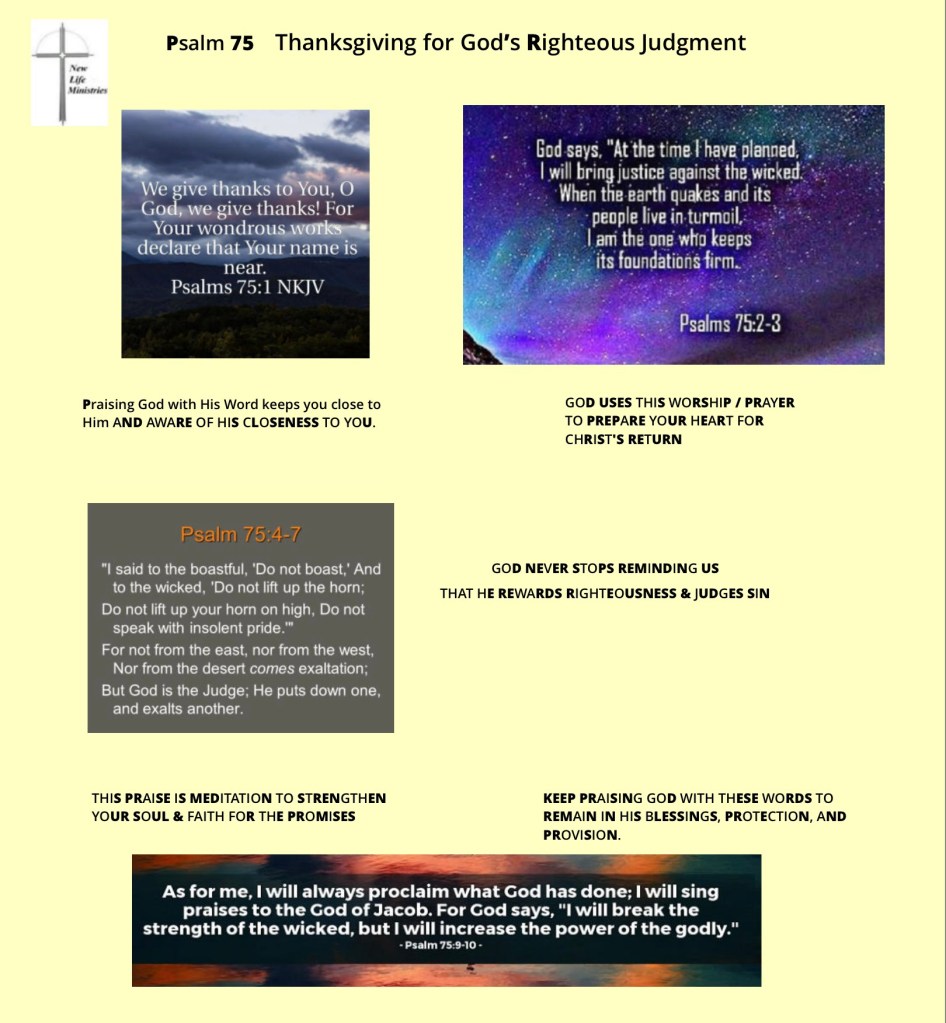
Psalm 75 is a good psalm to dig into to learn how to pray because it has a raw, honest flow that mixes gratitude, trust, and handing things over to God. It’s less a formula and more of a vibe you can lean into when you’re talking to God.
It teaches us that we don’t have to curse people, but we can ask for justice to prevail. It’s about trusting God because He’s the one who sorts it all out and gives righteous justice.
Psalm 75 starts by giving God thanks, then leans into trust and then asks God to do what is fair. If we stick with prayer justice will come. It’s less about coming to Him with perfect words, and more about keeping an open line between you and God.
As I’ve studied this scripture this week I’ve learned more insight. In Psalm 75:2-5 God said “At this time I will judge with equity. When the earth totters, and its inhabitants. It is I who keep it steady. I say to the boastful, do not boast, and to the wicked, do not lift up your horn, do not lift up your horn on high, or speak with a stiff neck.”
Here we see a promise, a reassurance, and a warning:
The promise: the promise is that God will judge all men, the wicked and the righteous fairly -with equity.
The reassurance: the reassurance is that when things on earth seems shaky and unstable, God is the steady force which keeps everything from falling apart he will not allow corrupting men to ruin what He needs to sustain.
The warning: the warning was directed towards corrupt who want to exalt themselves and pride and flex their perceived strength, which is a delusion.
Asaph in this Psalm knew that strength wasn’t achieved through the minds of men, but through the power of God.
it is God executes judgment, putting down one and lifting up another (Psalm 75:7).
Psalm 75:8 show us a interesting illustration, picturing God holding a cup of foaming wine. God is going to make the wicked drink the entire glass, all the way down to the drags, and it would steal their fate. Think about after you have drank coffee from a percolator and notice the dregs of a percolator coffee and see the fine coffee grounds that settle at the bottom of the cup. The dregs are the unwanted residue of coffee grounds or something that settle at the bottom of the cup or glass. God is saying the foaming wine will seal their fate. I think the true expression of this illustration is probably that the wine was fermented, and the meaning may be that the wrath of God seems to boil like fermenting liquor.
the hottie and corrupt we’re going to have to drink from the cup of God’s wrath. Psalm 75 ends with Asaph worshiping God for his inequitable judgment. God was going to cut off the horn of the wicked and promote His faithful people.
Can you imagine God sitting the most powerful people in the world down at His table -presidents and billionaires forcing them to drink a glass of His wrath against their will. In life, these people obeyed only themselves, they were ruled on earth, but God will sit them down like little children at the dinner table and make them finish what He has put in front of them. All of us must drink from a cup, and God allows us to choose from which cup we drink.
God’s cup of wrath awaits those who refused to submit to Him on earth. But Jesus poured another cup for those who wish to drink from God‘s grace.
He showed us His last supper with His disciples.
“He took the bread and when He had given thanks, He broke it and gave it to them, saying ‘This is my body, which is given for you. Do this in remembrance of Me,” likewise the cup after they had eaten, saying, ‘This cup that is poured out for you is the new covenant in My blood” – Luke 22:19-20 (paraphrased).
This text records Jesus instituting the Last Supper, which is a Jeus meal. I like to call it “the meal that heals.” It’s a meal Jesus’s followers can eat to remember His death.
The cup and its contents remind people that He gave on the cross to forgive sins. This is a cup for humble people to remember the humble Savior. We can come to His table willingly to acknowledge our dependence on God.
We all have a choice. Come to the table willingly to drink the sweet cup of God’s grace or be forced to the table to receive a very different drink.
Describe one positive change you have made in your life.
Changing my perspective on life is like flipping a switch in a dim room, everything looks different, even if the furniture stays the same. It’s about altering the facts but you interpret them.
Say you’re stuck in traffic. One lens sees it as a maddening waste of time, that spikes your stress, and your mood tank. Shift the frame, and you will see a chance to breath and listen to something in the radio that you love, it just think. Suddenly, the same delay feels neutral, maybe even useful.
But it’s not just me rattling on there is research the actually backs this up. Studies on cognitive reframing shows it can slash anxiety and depression by repairing how your brain processes setbacks.
It brings on a ripple effect bigger than you would expect. Viewing challenges as growth instead of threats builds resilience, psychologists calls it a “growth mindset,” and it’s linked to better problem-solving and less burnout.
Relationships shift, when seeing flaws in others as human rather than personal attacks which fosters empathy, and cuts conflict. Over time, this habit in perspective compounds. A life that was once heavy with frustration starts to feel light and becomes workable. You will find you don’t have to control the chaos, but you own the lens to change your outcome.
“Think twice before you speak once, because your words and influence will plant the seed of either success or failure in the mind of another” -Napoleon Hill
Finding fault with others seems to be a pastime of the ignorant. Understanding that we are meant to praise and lift each other up instead of tearing each other down creates a positive environment where people feel valued, supported, and empowered.
It’s a powerful act of faith and love that fosters a supportive environment that promotes reconciliation, healing, and unity.
Every day I keep my family lifted up in prayer. It’s a routine I’ve kept up on for years. Last night I got the dreaded phone call, that my son had been struck by a moving vehicle while he was walking through a parking lot.
He said a vehicle came out of no where, and the next thing he knew he was on top of the cars hood. He only sustained minor injuries – Praise God.
It’s always important to pray and mention specific needs. Like God’s protection over people. Revelation 5:8 tells us the “golden bowls filled with incense, which are prayers of God’s people. Golden bowls as prayers filled with incense symbolize that prayers of the saints, which are considered precious and pleasing to God.
Overflowing prayers suggest that God is receptive to and values the prayer of His people, and that they are not insignificant.
The fact that God receives these prayers and responds to them signifies that God honors the cries of His people and wants to work for us and through us.
Revelation gives us a fascinating picture of golden bowls filled with our prayers at the throne of God.
Please keep your family and friend lifted up in prayer. It’s a routine really does make a difference.
Our prayers offered in the “Name of Jesus,” delights Him not only has Jesus redeemed us, but He has also redeemed our prayers so that they surround God’s throne and are pleasing to Him.









 From Pity to Praise