
I am beginning a new Bible study at church on Revelation. But we can never understand the book of Revelation without first seeing the prophetic thread between it and the Old Testament. So, naturally, I thought I would bring you along in my study. This is what I found in the Bible Study Toolbox online.
The books of Daniel and Revelation are two of the most discussed and debated writings in Scripture. Both overflow with symbols, visions, and time markers. Because of this many people struggle to see how the two books connect. They are often read through the lens of partial preterism, which is the thought that Daniel refers to events that happened in the past and Revelation as something coming in the future. But a clear pattern emerges. The visions of Daniel are not abandoned or rewritten in Revelation, they are brought to fulfillment.
Jesus, Peter, and Paul all spoke of events that would happen in their generation. Revelation echoes this urgency. Daniel set the prophetic foundation, especially with his visions of four kingdoms and the coming of God’s kingdom. Revelation builds on that foundation, showing how the final pieces fell into place.
The four kingdoms of Daniel and the Beast in Revelation.
Daniel’s visions of four kingdoms in Daniel 2 and 7 sets the stage for Revelation’s letter images. In Daniel 2, Nebuchadnezzar sees a great statue made of different materials.
“As for this image, its head was of fine gold, its breast and its arms of silver, its belly and its thighs of bronze. It’s legs of iron, it’s feet part of iron, and part of clay” -Daniel 2:32-33
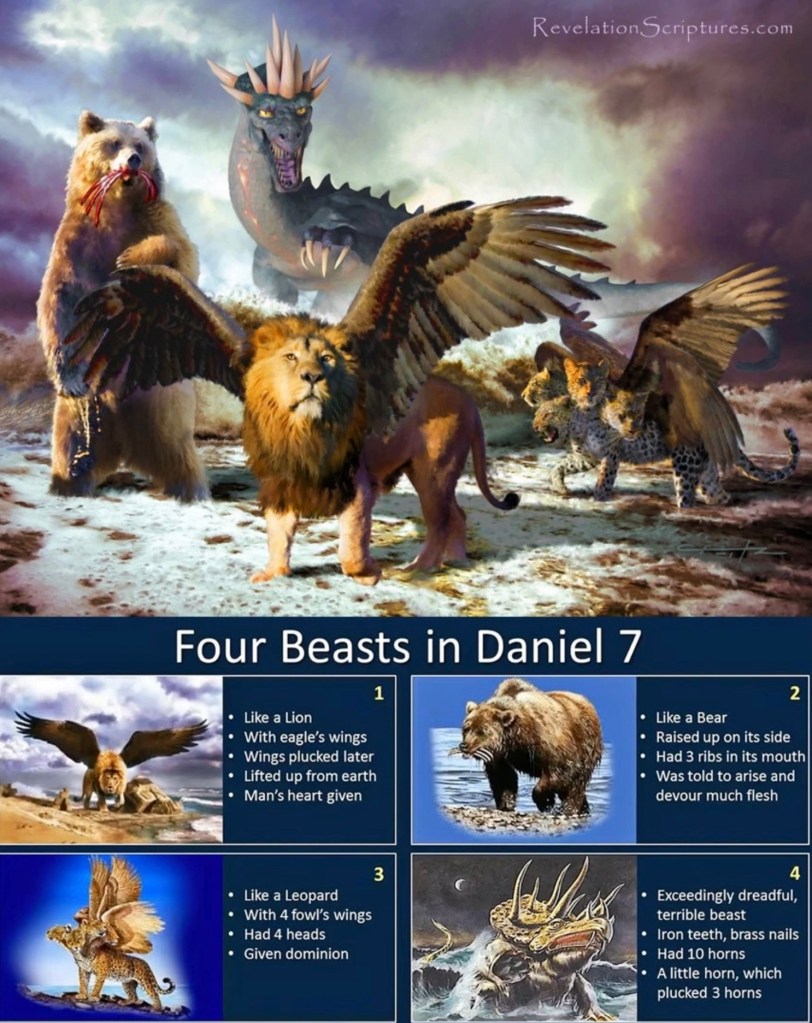
These parts represent a succession of kingdoms. Most scholars agree they are Babylon, Medo-Persia, Greece, and Rome. Daniel’s later vision in chapter 7 matches this timeline with four beasts rising from the sea.
“For great animals came up from the sea, different from one another” -Daniel 7:3
These four beasts correspond to the statue’s metals, ending with a terrifying fourth breast -Rome. Revelation picks up this exact imagery.
“The beast which I saw was like a leopard, and his feet were like those of a bear, and his mouth like the mouth of a lion. The dragon gave him his power, his throne, and great authority” -Revelation 13:1
John’s beast blends the earlier ones. This symbolizes Rome as the final earthly kingdom before God’s full judgement comes. The beast is not a new vision but an expansion of Daniel’s fourth beast. It rules with terror and opposes the saints (saints are any person who has put their trust in Jesus and has been set apart). Yet it cannot overcome them.
Because Daniel’s fourth kingdom aligns with Rome, and Revelation’s beast also aligns with Rome, we can see a consistent timeline. The church faced Rome’s persecution in the first century. Because this beast is active during John’s timeline, it matches both prophecy and history.
The Time of the End: Not the End of Time
One of the most important points in Daniel and Revelation is the use of time. Many reader readers assume these books speak about the end of the world. But Daniel is clear about “the time of the end,” not the end of time.
“But you, Daniel, shut up the words, seal the book, even to the time of the end. Many will run back and forth, and knowledge will be increased” -Daniel 12:4
Daniel’s visions were sealed because they were for a later generation. But Revelation speaks of things that must “soon take place.”
“Do not seal up the words of the prophecy of this book, for the time is near” -Revelation 22:10
This contrast is powerful. Daniel is told to seal His book. John is told not to. The implication is clear. They were not thousands of years apart, they fit perfectly with Jesus’s statements in Matthew 24.
“Most certainly I tell you, this generation will not pass away, until all these things are accomplished” -Matthew 24:34
When we read Daniel and Revelation together, we see that Daniel’s “time of the end” becomes John’s near fulfillment. The fall of Jerusalem in AD 70 marked a major shift in God’s covenant dealings. It was not the end of time, but it was the end of the old covenant age.
[I would like to get a little off topic here. There are people in America who are preaching “Replacement theory”: that God has replaced the Jewish people as His chosen. If God has replaced his chosen people in Jerusalem, doesn’t that mean any of his children can be replaced because they sin? If so then none of his covenants with anyone are true and he can reject anyone at any time. That is not who God is, and none of his Bible is true.]
The Abomination of Desolation and the Great Tribulation
Daniel introduces a mysterious phrase: “the admonition of desolation.” Jesus quotes it directly in His warning to the early church.
“On the wing of abominations will come one who makes desolate, and even to the full end, and that determined, wrath will be poured out on the desolate” – Daniel 9:27
“So when you see the abomination of desolation spoken through Daniel the prophet, standing in the holy place (let the reader understand” -Matthew 24:15
Jesus interrupts Daniel’s prophecy. He places the fulfillment in His generation. The abomination is tied to the destruction of Jerusalem, Revelation echoes this judgment in the fall of “Babylon the Great.
“Fallen, fallen I’d Babylon the great, and she has become a habitation of demons, a prison of every unclean spirit, and s prison of every unclean and hateful bird” -Revelation 18:2
Babylon is a symbol, not a city on the Euphrates. The evidence within Revelation points to Jerusalem, the city where the Lord was crucified (Revelation 11:8 ) as a symbol of Babylon. The judgment described in the book is plagues, trumpet blasts, and bowls of wrath that culminate in the destruction of the great city.
So Daniel’s abomination marks the beginning of the final judgment. Revelation shows the outcome. Together, they represent one story of covenant judgment fulfilled in the first century.
The Son of Man and the Coming of the Kingdom
Daniel’s vision of the Son of Man coming with the cloud is central to both books.
One Story, One Fulfillment
When we study Daniel and Revelation side by side, we begin to see a single prophetic story. Daniel provides the blueprint. Revelation confirms the building is finished. They do not point to the end of the world but to the end of the age. That age. The age -the old covenant system centered on temple worship – was brought to a close in AD 70
Revelation is not a rewrite of Daniel. It unveils how Daniel’s visions were fulfilled. Jesus came as Son of man, received His kingdom and will never be shaken.

