

“Feelings are not facts” it’s one of those phrases and sound dismissive. But, I don’t mean it that way. Emotions carry information about our needs and experiences, and while emotions contain truth, they don’t always lineup with what’s happening.
Sometimes our feelings point us in the wrong direction. For example we might meet someone and instantly feel disliked. That feeling can be very convincing, and it may lead us to believe that the person has something against us. But that feeling may be an interpretation of the moment. That person might be simply preoccupied or having a bad day, which has nothing to do with us.
When we treat emotions like facts, it can spiral into anxiety, stress, and misunderstandings.
Many of us have a history of negative feedback in social interactions, which can lead us quick to internalize and personalize the negative emotions we pick up around us. When someone near us seems to be upset, we might assume it’s because of something we did. That assumption often grows out of past experiences where we were unintentionally the cause of someone’s reaction, or we were criticized for not fitting Neurotypical expectations. This can overlap with rejection sensitivity.
This assumption isn’t always correct. Sometimes the negativity we sense has nothing to do with us. Because of our history, we believe it does and respond accordingly. We react to the assumed negativity which can draw actual negative responses from others, which then reinforces the original assumption.
Telling the difference between emotions and facts can be hard, especially when a feeling is intense.
This is the chart that I learned to tell the difference between:
Emotions:
- Emotions are shaped by our history, beliefs, and context.
- Emotions can shift quickly, sometimes within minutes.
- Emotions carry information about our needs.
They can feel convincing, if they are intense.
Facts:
- Facts are things we can observe or check
- Facts stay the same, no matter who is looking
- Facts can change when more evidence comes in
- Facts don depend on how we feel about them
Emotions are definitely work listening to. They just aren’t the same thing as objective information.
If we suffer from anxiety, it shapes our emotions. It’s easy to fall into the “anxiety loop” a cycle of negative thoughts and feelings that plays on repeat. Once we’re in that loop, our interpretation of the situation could start to feel like truth.
For example, if our boss approaches us with a certain tone, it’s easy to read the tone as negative, it’s easy to conclude they are displeased with us. But from there we can spiral and who worries about incompetence or losing our job.  from there our mind to spiral into worries about incompetence or losing our job and then into thoughts like “I’m not good enough” or I am worthless.” none of these thoughts were based on what happened, yet they start to feel true.
Our nervous system can respond to these loops as though the threat is happening now, which makes the feeling harder to doubt.
When we notice we’re caught in a spiral, it helps to pause and ask, what are the facts here? Sorting what we can observe from the story and what we built in our minds can loosen the loop.
If you are like me, this is tender ground. Many spent years being told we were too sensitive, too reactive, and too much. Chronic validation like that shapes our self-concept, keeps us on high alert, and wears down our ability to trust our own experience. So our quick, anxiety-driven assumptions, can come from years of negative feedback, self-criticism, and the alienation of not feeling like we fit in. I have found it helps to honor where these reactions come from.
The challenge is taking our view, seriously without accepting every thought as absolute truth. We can easily take our emotions as fact without checking it. I think there’s a hard irony here. When people spent years telling us, our feelings were wrong, being asked to question our thoughts and feel like more of the same. Questioning our automatic assumptions takes practice, and it starts from trusting that the feeling makes sense.
When the line between our emotions and what’s happening, blurs, it can affect several parts of our lives.
We can make choices based on our emotions rather than what’s in our best interest. Treating our emotional reactions as an indisputable truth makes it hard to see the other person’s side, and conversations can turn very defensive. We can miss what is underneath the feeling. Emotional reasoning is the habit of including something is true because it feels true, and reinforced believes we were already told.
Persistent negative feelings taken as facts feeds anxiety, lower our mood, and can give us a sense of hopelessness.
We can begin to separate emotions from facts. When something feels off, the goal isn’t to push the feeling away. Ignored feelings can’t just stick around, and it usually works better to get serious about the feeling and what’s feeding it.
Here is a chart to help to distinguish emotions from facts:
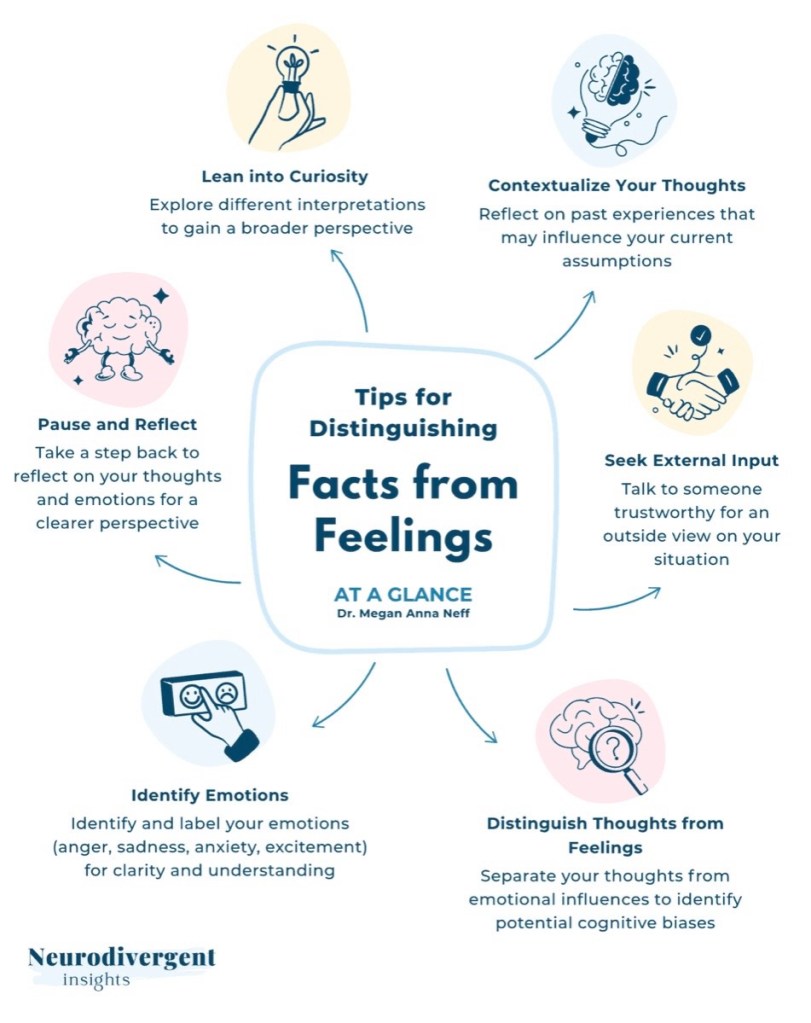
Our emotions are powerful and deeply personal, and they can feel completely true. They still aren’t facts. Learning to validate our experience without falling into the feelings as backstrap. It’s a balance we have to keep practicing.

