My favorite candy bars are Rocky Road or Heath. It depends on what I’m in the mood for.
A Rocky Road is a fluffy, soft marshmallow center topped with roasted cashew nut covered in a layer of milk chocolate. It was introduced in 1950.
A Heath is a classic American candy bar that has a thin, hard and crunchy center of buttery English toffee covered in a layer of milk chocolate. It was introduced in 1928.
Every woman who walks with God has a story to tell. There is a faith journey even in the hardships, revealing God’s faithfulness, turning struggles into testimonies of hope, strength, and divine intervention.
We see this in the accounts of the Bible with Sarah, Hagar, Esther, Hannah, Ruth, and Rahab. It should inspire us with examples of grace, purpose, and perseverance through life’s challenges.
The key themes of these accounts are:
Faithfulness and hardship: Hagar in the desert. Ruth is facing loss, showing God’s presence in desolate times.
Transformation and purpose: Rahab, a prostitute used by God, and Esther elevated from obscurity illustrate how God can use anyone for His glory.
Answered prayers: Hannah’s account is a classic example of God answering prayers.
Hope in the impossible: The woman with the issue of blood, Mary (the mother of Jesus), and Martha (Lazarus’s sister), demonstrate God’s power over failure, divine will, and death.
God remembers acts of kindness showing that God honors those who help others.
Whatever season of life you’re in waiting, hurting, questioning it’s part of your unique story.
God uses trials to build strength and faith, making your story one of victory.
By walking with God, your own story of breakthrough and purpose is still being written.
As for something I never get done, my to do list is pretty short. But there is one thing that never seems to get done, and that’s cleaning out closets, it’s not that I’m too busy, it’s because it’s something a dread.
Rewards in heaven, glorify God, and provide us with joy, peace, and wonder as we pursue godly, living and surrender to God‘s in us and through us. Rewards in heaven are the completion of our earthly salvation experience and those rewards will be extremely satisfying. 
The crown of rejoicing
The crown of the soul winner
The crown of righteousness
The crown of life
The imperishable crown
In 1 Corinthians 9:24-25 Paul best defines for us how these crowns are awarded.
“Do you not know that those who run in a race all run, but one receives the prize? Run in such a way that you may obtain it. And everyone who competes for the prize is temperate (disciplined) in all things. Now they do it to obtain a perishable crown, but we for an imperishable crown.”
How these crowns are awarded:
1. The crown of rejoicing
The purpose: The apostle Paul tells us in Philippians 4:4 to “rejoice always in the Lord” for all the bountiful blessings our gracious God has showered on us. As believers, we have more in this life to resource than anyone else.
“Rejoice in the Lord always. Again I will say rejoice.”
Luke 15: 7 tells us there is rejoicing even now in heaven.
“I tell you that even so there will be more joy in heaven over one sinner who repents, than over ninety-nine righteous people who need no repentance.”
The crown of rejoicing will be reward for believers where.
“God will wipe away every tear from their eyes there shall be no more death, nor sorrow, nor crying. There shall be no more pain, the former things have passed away” -Revelation 21:4
2. The crown of the soul-winner
The Purpose:
Rewards for faithful service
“For we must all appear before the judgment seat of Christ, that each one may receive the things done in the body, according to what he has done, whether good or bad” -2 Corinthians 5:10
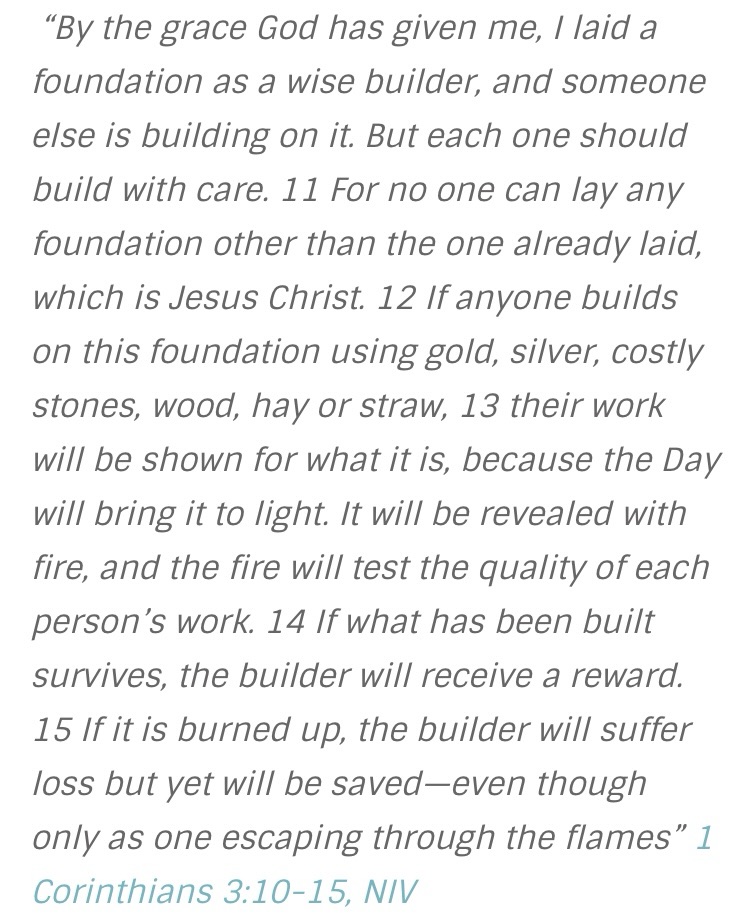
1 Corinthians 3:10-15
Proverbs 11:30 tells us “The fruit of the righteous is s tree of life and the one who is wise saves lives.”
3. The crown of righteousness
The purpose & recipients:
We inherit this crown through the righteousness of Jesus which is what gives us aright to it, and without it cannot be obtained. It is an everlasting crown, promised to all who love the Lord and eagerly wait for His return. Through our enduring discouragements, persecutions, sufferings, or even death, we know our reward is with Jesus in eternity.
“I have fought the good fight, I have finished the race, I have kept the faith. Finally, there is laid up for me the crown of righteousness, which the Lord, the righteous Judge, will give to me on that day, and not to me only but also to all who have loved His appearing” -2 Timothy 4:7-8
We are citizens of heaven, where the Lord Jesus Christ lives, and are eagerly waiting for Him to return as our Savior. He will take our weak mortal bodies and change them into glorious bodies like His own, using the same power that He will bring everything under His control (Philippians 3:20-21).
Finish the race, then the reward.
4. The crown of life
The purpose
This crown is for all believers. We know that our earthly lives will end. But we have the amazing promise that comes only to those who come to God through Jesus.
“And this is the promise that He has promised us -eternal life” -2 John 2:25
This crown will be given to those who successfully endure temptation and suffering, who bravely confront persecution for Jesus to the point of death.
“Blessed is the man who endures temptation, for when he has been approved, he will receive the crown of life which the Lord has promised to those who love Him” -James 1:12
Revelation 2:10-11 tells us, “Don’t be afraid of what you are about to suffer. The devil will throw some of you in prison to test you. You will suffer for ten days. But if you remain faithful even when facing death, I will give you the crown of life” (NLT). Revelation 3:11 tells us to hold fast to what you gave because the Lord will come quickly, to be sure no one will take our crown.
5. The imperishable crown
Paul gives us an analogy of the Olympic athlete to explain this reward.
“Do you not know that those who run in a race all run, but one receives the prize? Run in such a way that you obtain it. And everyone who competes for the prize I’d disciplined in all things. Now they do it to obtain a perishable crown, but we got an imperishable crown” – 1 Corinthians 9:25-25
Paul explains that he exercises His godly liberty by living a life of disciplined endurance. The Corinthians were familiar with the Isthmian games which were a major festival in ancient Greece to honor the sea God Poseidon and Paul used that knowledge to teach them that they should live a godly life with a certain motive. The motive is to win an incorruptible crown, an honor bestowed by God. He provided himself as an example of such a life with the illustrations of a runner and a boxer.
“Therefore I do not run like someone running aimlessly. I do not fight like a boxer beating the air. No, I strike a blow to my body and make it my slave so that after I have preached to others, I myself will not be disqualified for the prize” -1 Corinthians 9:26-27
To reward the winner of an Olympic-type race. This kind of reward points to a permanent honor that Jesus will bestow upon those who live by the Holy Spirit restraint which keeps them qualified for ministry.
I think to get this, prize we need to live out our call in this life. In other words to master our old sinful nature. We need to learn how to deny ourselves for God’s glory that we might be honored at the judgment. which is quite difficult living in a broken world that pushes us toward sin at every turn.
Rewards in heaven glorify God and provide us with joy, peace, and wonder as we pursue godly living and surrender to God’s work in us and through us. Rewards in heaven are the completion of our earthly salvation experience and those rewards will be eternally satisfying (Psalm 16:11).
I believe there are two important inventions of my life time. One being the Automated Teller Machine (ATM). The freedom to get money out of your banking account any time you want has been a great convenience. Introduced by John Shepherd-Barron.
The other important inventions is the heart transplant. Invented by Dr Robert Jarvik a massive milestone in medical science. It has saved many lives since it was invented.
A promise from God always requires a process. God is more interested in the journey than the destination. His promise involves a journey of faith, obedience, trust, and perseverance.
There are steps in this process:
God offers us promises through His grace, but receiving them requires a response of faith, trusting His Word even when the path isn’t clear.
God provides the promises but we as believers walk the path of growth and character development to receive it in His perfect timing.
We may need to take a step of obedience, like Abraham did, leaving the familiar to go where God leads.
Staying humble, turning from sin, and walking with God through prayer and seeking Him, not just times but also in troubled times.
We need to meditate on biblical promises, speak them aloud, and agree with God’s Word, not our circumstances, living as if the promise has already been delivered.
This process involves perseverance and patience. The process builds faith and character, that often requires long suffering, and worshipping while waiting on God’s perfect timing.
God leads us to an intimate relationship with Him, and this is crucial because He makes promises based on knowing us and seeing what’s in our heart.
We need to recognize that entering into the promises of God often requires battling lies in our minds, which acts as a battleground for claiming our inheritance.
God is the promise keeper and His promises are assurances that He will fulfill His word and provide for us. Throughout the Bible, God has a flawless track record of keeping His promises from Noah to Moses.
God does not change Hebrews 13:8 emphasizes that Jesus is the same yesterday, today, and forever. He is faithful to His promises encouraging us to hold on to hope.
As I was reading the other day, I read something that really suck with me, “Heaven is the gift, but our journey reveals the giver.”
We can trust God to keep His word simple because He is faithful in all He does (Psalm 145:13. God‘s faithfulness is the anchor in our storms. His nature guarantees His promises, because He cannot change. He cannot break His word. Rest in His faithfulness knowing every promises finds it’s “Yes” in Him.
My childhood wasn’t the greatest and because of my childhood and as a result, I’ve made some bad choices. It’s crazy how when your told every day you are a worthless human being can brainwash you into actually believing that. And believing that causes you to do something that “normal” people would never do. Brains are powerful, complex organs that control many things like thought, memory, and emotion. Thankfully with a lot of hard work we can change how our brains perceive things. And once we can change our perspectives our life changes too. The hard thing is our desire to change. Albert Einstein said, “Insanity is doing the same thing over and over again and expecting different results.”
If we can change our perspective it changes our lives.
There is a Parable of getting ready for Jesus in Matthew 25:1-13 planning for a beautiful wedding, 5 we’re ready and 5 we’re not. This is not physical readiness but Spiritual readiness.
Right now we must prepare for our wedding with Jesus, this means having Spirit-filled faith (the oil) and being clothed in Christ’s righteousness not just outward religious acts, to be ready for Jesus’s return as a bride getting ready for her groom.
I once heard a good example of being prepared for Jesus’s return. Imagine a groom standing and waiting for a beautiful bride. When she came down the aisle and he was awed at her beauty knowing she had prepared for this day with great excitement. Now imagine the same groom waiting for his bride but when she came down the aisle, she was in an old stained dress, and she hadn’t prepared at all and wasn’t excited in the least. Do you think the groom would accept her?
This parable symbolized the wise virgins’ preparedness with extra oil for their lamps, representing inward spiritual life, not borrowed faith. It’s about an intimate relationship with God, making us holy and prepared for the unexpected arrival of our Bridegroom Jesus.
There are a few key meaning we need to pay attention to:
Bridegroom (Jesus): Coming for His Church (us) at an unknown time.
The Virgins (Believers): They all looked similar, but have different levels of readiness.
Lamps: These represent outward profession of faith or testimony.
Oil (The Crucial Element): This represents the Holy Spirit, genuine faith, inner spiritual life, and a personal relationship with God.
Wedding Grament: This symbolizes, righteousness, holiness, and being pure for Jesus. This is described in Revelation 19:7-8,
“Let’s rejoice and be exceedingly glad, and let’s give glory to Him. For the marriage of the Lamb has come, and His wife has made herself ready. It was given to her that she would array herself in bright, pure, fine linen for the fine linen is the righteous act of the holy ones.”
Wise Virgins: They took extra oil prepared with inner substance and relationship with God.
Foolish Virgins: They took lamps but no extra oil, lacked genuine spiritual supply and intimacy with the Bridegroom.
I think we need to prepare our garments for the wedding and spiritual readiness. It’s important to cultivate our intimacy with God, not just with activity. We need to focus on abiding and receiving the God and the Holy Spirit, rather than just preforming religious duties and stop confusing activity with intimacy.
Actively seeking the Holy Spirit, he is the source of true faith and readiness, which cannot be earned or borrowed.
We need to live in righteousness which clothes us in Jesus’s righteousness through a life transformed by Him, this makes us holy and without blemish. Ephesians 5:27 tells us we should not have a spot or wrinkle or any such thing, but should be holy and without defect. The only ways to do that is through living righteously.
We need to stay, vigilant and present. This parable stresses constant readiness for Jesus‘s return, which could be at any moment.
The foolish virgins were unknown to the bridegroom, we need to be focused on knowing Him, not just knowing about Him.True preparation involves a personal, relational knowledge, and not just outward appearance.
In essence, preparing our wedding garment means having a heart filled with God’s spirit and a life clothed in his righteousness, ensuring we have genuine “oil” of faith and a relationship to welcome Jesus when He comes.
I don’t watch or play sports. But I watched when my son played baseball when he was young. I’ve always held the idea that sports were a pacification tactic historically formed to distract people from political apathy, loss of rights, or corruption. During the Roman Empire, the government called it “bread and circuses.” It’s difficult for me to move past the original purpose of sports because they were founded as a raw, essential, and symbolic ground for human survival, rather than merely entertainment for a business.
We are living in a time of deep, spiritual confusion, where truth is trampled, wickedness is celebrated, and the name of God is mocked. The nation is not only in political turmoil, it is in spiritual freefall.
Yet, we are not without hope. Throughout history, when people have cried out to God in repentance and desperation, God has always answered. In these challenging times, we need to have a supernatural move of God. An awakening needs to happen.
While good things are happening if people don’t become spiritually awakened nothing will change.
Many people are looking at God as the enemy. Satan counterfeits God’s work to create spiritual confusion. America is experiencing spiritual shifts, with rising personal spirituality with many seeking to fill that God shaped hole within them in other places.
The internet offers endless spiritual paths, from ancient wisdom to new age beliefs, along with a cluster of other religions brought in when the last administration was in charge.
Do be direct I think people want to come here for our prosperity, but then still want to practice and force their religion on us. America didn’t get prosperity by following other religions, we got it by following the One true God.
America isn’t less spiritual, but the fast shifting of social values and increased secularism leads people to questioning and often times confusion.
Satan aims to obscure truth, create doubt, and hinder people’s true purpose in life which leads to unclear identity, indecision, distorted reality, and emotional turmoil, through deceptive thoughts, distractions and manipulation. I believe this is what we are seeing today. We need to focus on Jesus, seek God’s Word, and have clear headed discernment of the times in which we are living.
1 John 4:1 says, “Beloved , do not believe every spirit, but test the spirits to see whether they are from God, for many false prophets have gone into the world.” This verse instructs us to discern true spiritual messages from false ones, the key test being whether they are spirit confesses the Jesus aligns with their own spirit.
We’ve all been caught in the storm watching flood waters rise, and wondering how we got there. Thinking where is God in our storm when our arms are weary, our souls are battered, and life has left us breathless.
It is here, in the midst of the storm, that we have two choices. Am I going to allow God to use this storm, or allow the storm to shatter us, and push us away from God? In the midst of stress, pain or heartache, it can be so easy to allow the storm to make us bitter, to let it drive us away from everything God has planned for us.
When it comes down to it, this is a choice only we can make. We can let God refine, shape, and define us through this broken place, or it can sweep in like a tornado and destroy everything in its path. We can hunker down in our pain or depression or loneliness, or we can lean into God, and allow Him to lead our steps and fill our souls.
It’s times like this, as we sit in the storm, it’s easy to feel alone, like no one sees and no one cares. But even in the storm, at the darkest moments of your life, He is there. And because He is God even in the storm, you cannot be list to Him, even in the storm you are still His child. He saw this storm before it even reached you, and had already worked out what you need to go through it. He will see you through the storm. But trusting God is the key.
At times it can feel impossible to trust God when we are struggling in the storm He knew was coming but did not save us from and from our perspective to see why we had to endure the storm. The answer is, because we live in a fallen world, or God had a plan through it all, or because we made poor choices.
Regardless of the reason why, God can show up “big” and pour His grace, mercy, and love into our lives in our storm-battered souls. Sometimes we have to go through a storm so that it can strip away everything false that we rely on so we are forced to rely on God.
Our storms are the thing He uses to reveal His goodness and love. Through it, we often see His power in great ways.
I think a great example of this is when the disciples Jesus performed the miracles of feeding the 5000 in Matthew 14. He immediately told them to get into the boat and go to the other side of the Sea of Galilee, while He dismissed the crowds. He sent them, and they obeyed.
Then while Jesus was alone praying, the wind started howling and their boat started rocking. They were afraid they cried out, after they had struggled for a long time, battered by the wind and waves before Jesus showed up to rescue them, the winds ceased. (Matthew 14:32). Then the disciples cried out, “Truly you are the Son of God.”
Between the time Jesus sent them across the Sea of Galilee, and the time He arrived to save them, did they wonder if He had forgotten them? Were they angry that He had sent them? Did they doubt His faithfulness?
Even knowing He is God in the storm isn’t always enough in the face of the storm, it’s still easy to find doubt creep in.
God told us in Isaiah 43:2, “When you pass through the waters, I will be with you, and when you pass through the rivers, they will not sweep over you. When you walk through the fire, you will not be burned, the flames we not set you ablaze.”
I think it’s important that when we are going through the storm, we need to cling to all the past storms God has been with us through. The storms of life are used to build on what we learned when everything was going right. As uncomfortable as the painful seasons are in our lives we need them to grow and stretch us.
The storms may not be sent by God, but He can still use them. They teach us to lean into prayer and lean into the Bible.
They reaffirm what we know in our hearts, for the next time we go through a storm. And give us a solid foundation to stand with confidence that He is God in the storm, and He will never abandon us.
“So do not fear, for I am with you, do not be dismayed, for I am your God, I will strengthen you and help you, I will uphold you with my righteous right hand” -Isaiah 41:10