I hate when people ask me, “Why are you so different? I usually answer “Because I don’t follow the herd? I know I have a different perspective on things than most people. Possibly because of the experiences I’ve had to endure throughout my life.
Remember everyone has something they are struggling with in their life. Be kind.
Our choices shape our futures. I wish someone would have told this to me when I was younger, and I would have listened. But I didn’t listen to anyone but myself back then.
Life is a series of choices. To some, that’s too simple, but it really is true. Our decisions determine our destiny.
Every decision brings us closer or further away from God’s plan. There is no such thing as just sitting still or putting God’s plan on hold. That’s a deception, God’s will for us is intertwined with His will for others, and that’s a constant moving and changing dynamic. It’s like catching a flight. We can miss it.
It’s true that God get us to our destiny in some other way. He is certainly smarter than any GPS device that recalculates us when we miss a turn. There is always a later flight with God. But who wants the hassle, disappointment, and delay that comes from missing a connection? I want God’s best. Don’t you?
When we go on a road trip, those ahead of us can be a valuable source of information. It doesn’t matter how we feel about them personally. The fact that they have driven the road gives them insight of what we might need. They can tell us what accommodations and restaurants are available. Or they can let us know of a wreck or construction route. We would be foolish to of to draw on the insights of others who have gone before us.
Everyone has challenges, failures, pasts, and successes that has stood in the way of them following God’s will for their lives. But with a few good decisions anyone can turn their lives around.
Every one of us have a God ordained destiny that is designed to touch others. We carry other people’s miracles. I don’t think we can fully comprehend this. It is certain however, that the lives of millions of people were changed simply because the “hero’s of faith made the right decision.
I think back to when my entire life took a u-turn. All I needed was a little bit of hope.
I had went to a church conference with a lady who didn’t want to go alone from a prayer meeting I was attending at the time. The conference was 4 days long, and to say I was dreading it would be an understatement. The morning meeting was basically like church, but a lady dressed in a prayer shawl came up to me, and said, “you’re live is about to change, and you will become a bridge for others.” My first thought was, “is this lady for real?” She knows nothing about what I’ve been through, how can she possibly know that. WoW was I wrong. It was then my life began to change for the better, It put me on the right path.
Are the decisions we make every day what the Lord wants us to make?
Most people don’t intentionally decide to miss their destinies, they just get busy with the cares of life, and before they know it, they are in a rut that they can’t seem to get out of.
Remember, our lives are a result of choices. Others can influence or hinder us, but our choices are the determining factor of our destinies. And it’s never too late to make the right choices.
My life started when I made the right choice to have faith in what the lady at the conference told me. I just needed a little bit of hope, and someone who believed in me.
“Therefore I urge you, brothers (and sisters), by the mercies of God, to present, your bodies a living sacrifice, holy, acceptable to God, which is your spiritual service. Don’t be confirmed to this world, but be transformed by the renewing of your mind, so that you may proves what is the good, well-pleasing and perfect will of God” -Romans 12:1-2
God showed me His will for my life was to be completely committed to Him.
Each of our stories can be a testimony of God‘s miraculous power and goodness that can encourage us to make the right decisions toward our own divine destiny.
God has some awesome things planned for your life. Regardless of what things look like now, your positive decisions can change everything.
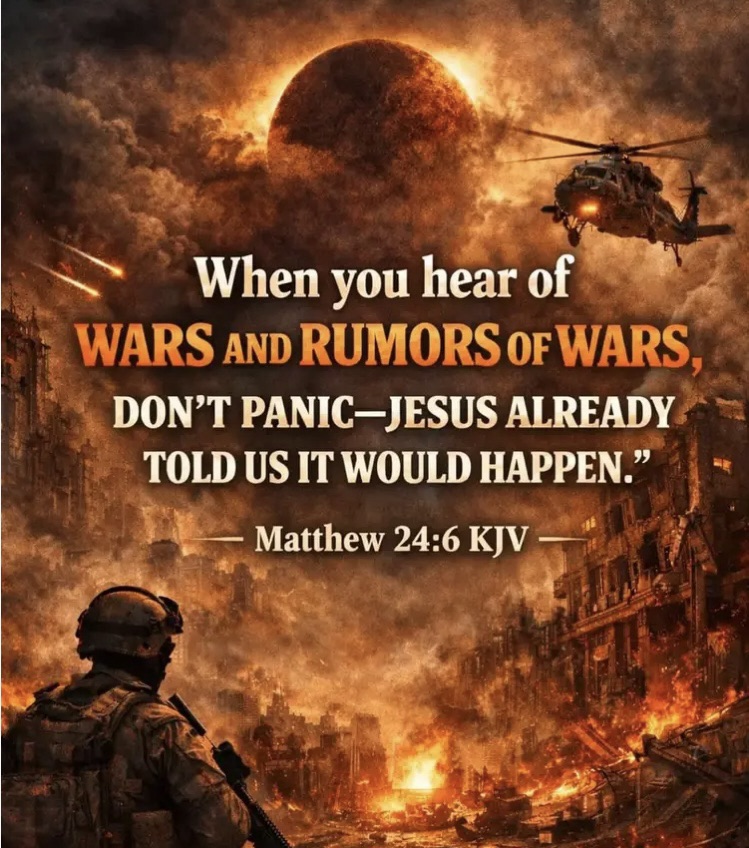
Conflict, violence and global unrest are not signs God has lost control. They remind us that prophecy is unfolding exactly as Jesus said.
Luke 21:28 says, “And when these things begin to come to pass, then look up your heads, for your redemption draws nigh.” The world may panic, but believers rare called to watch and pray. “God is our refuge and strength, a very present help in trouble” (Psalm 46:1).
Wars show us that human systems cannot bring lasting peace, but Isaiah 9:6 calls Jesus the Prince of Peace. Instead of fear, let these events awaken you spiritually. Let them push through you to repentance, deep faith, and readiness for Jesus’s return.
The shaking of nations is not meant to terrify the faithful, but to remind us that this world is temporary and Jesus’s kingdom is eternal. It is time to stay alert, stay grounded in God’s Word, and trust that God’s plan is moving forward exactly as He said it will happen.
I believe every failure is essential has the potential of turning errors into improvements. Failure isn’t a sign of incompetence, but a necessary part of success. Every failure provides us with data that brings us closer to success.
Each failure can serve as an educational tool. But to make it work one must maintain persistence and a positive attitude. The key is to learn from our mistakes, overcome them, and come back stronger.
Has anyone noticed there’s a direct conflict between man’s law and God’s law? The world has increasingly advocated tolerance of everything except Jesus. If we are going to follow God’s law, we must learn to live with pressure, and be guided by the truths we find in the Bible.
There will come a time when obeying God’s law will mean disobeying man’s law. And I believe it will become more challenging as time goes on.
After all, the world’s authority is given by God Himself. Our observance of the law is a positive public testimony of our faith. Obedience to God is always the right thing to do.
The government should not impose any law that goes against God’s law. If they do, the world will crumble. After all authority is given by God. We as followers of God are not bound by any government that places itself above God’s law. We need to take care to know when obedience to the government entails disobedience to God.
It takes courage to stand for what is right in our world today. It takes courage to stand strong and not condone, or compromise, what is clearly opposed in God’s Word. God gives us struggles to strengthen us.
As followers of Jesus we are commanded to stand true to the Word of God.
The more confident we are of the promises in God’s Word, the more inspired we are to obey Him.
Faith is often thought of as a thing we have – a belief in something or someone. But according to the Bible faith is more than a passive possession, it’s a firm confidence that results in action. Action follows every mention of faith.
Noah prepared the Ark, Abraham obeyed without knowing where he was going,
Instead of sitting back we as believers should count on God’s promises and act accordingly, as did the people in Hebrews 11.
The Lord accomplished amazing feats through their lives when they believed Him and moved in obedience. Like a muscle, faith grows. The more we put it into action. We can strengthen our trust in God and His promises, even if we don’t live to see the fulfillment in our lifetime.
We can choose to let God use us by letting biblical truths and His character and power shape our thinking and response.
There are a few objects I could not live without, such as food, water, and shelter, because they are essential physiological needs that require homeostasis that provide energy, and protect the body.
I would also have a difficult time living without coffee, or a warm blanket for those cold nights. And maybe a dog or cat to keep me company. These objects are not essential m but they would make life more joyous.
Every trial we endure that makes us feel hopeless always serves as a test to refine our faith, ultimately producing endurance, character and spiritual maturity.
When situations appear insurmountable, they can draw us closer to God or further away from Him. They either foster dependence on Him, rather than self-reliance.
James 1-2-4 encourages viewing our trials ad joy, as the testing of faith produces endurance. Any trial we face are not wasted but refines our character and demonstrates God’s faithfulness.
When I find myself in a trial that seems hopeless, I try to ask God, “What do you want me to learn through this?” As with any life journey, it’s all about perspective. If we go in thinking “This is going to be horrible,” it probably will because that’s what we expect.
We can learn about intimacy with God from looking at Moses and Jesus and their progressing from general awareness to profound face to face fellowship, emphasizing a journey from outward experience to inner transformation through revelation, faith, and dedication.
We hinder our intimacy with God by interns barriers like pride, unwillingness to change, and shame, as well as external distractions such as busyness, worldly desires, and people pleasing, along with spiritual obstacles like unconfessed sin, self-reliance, and doubt.
It can seem that with all the things against us, we are doomed to live away from God. That’s why it’s so important to make time for Him every day in prayer, and studying the Bible. We need to have humility, and repentance, and prioritization.
Moses maintained a place outside the camp to meet with God, where the Lord spoke to him, as a man speaks to his friend. He also frequently interceded for the Israelites, actively standing between them and God’s judgment, which deepened His reliance on God.
Despite leading millions, Moses remained the “meekest man on earth, prioritizing God’s will and instructions over his own, which allowed him to grow in understanding God’s ways.
Moses was not satisfied with just God’s promises, he demanded to see God’s glory and wanted to be in His presence. Moses tells God in Exodus 33:15, “If your presence does not go with us, do not send us up from here.” Moses prioritized God’s company over the promise of His presence, without being promised that he would go into the promised land with his people.
Through these actions, Moses built a lasting, intimate friendship with God that was characterized by trust, dialogue, and a proud desire to know God’s ways.
Intimacy is built through consistency rather than a single event, we need to focus on inviting God into our ordinary moments.
One of the most difficult phases in life that we all go through is the phase of grief. Mine was of my father. Moving past the intense, early, phase of grief involves actively processing emotions, establishing routines, and practicing self-care.
I took care of my father for the last 10 years of his life. In that time we became very close. One thing I learned in the process of grief is that fighting my feelings didn’t work. I had to allow myself to cry and experience the pain to move through it. That being said, it took me 6 years to even open a box of his possessions.
Still, today if someone says some quirky thing my father used to say, the memories come flooding back and I get emotional.
It’s something I’m sure no one who has grieved someone can relate to.











 From Pity to Praise