

What Does The Bible Say About Tattoos?
Bible Answer
The word tattoo occurs only one in the Bible. It is found in the Old Testament in Leviticus 19:28
You shall not make any cuts in your body for the dead, not make any tattoo marks on yourselves: I an the Lord. Leviticus 19:28
You shall not make any cuts in your body for the dead, nor make any tattoo arks on yourselves. I am the Lord
This passage is talking about tattoos which are part of a religious ritual worship was common. Another example of this occurs in 1 Kings 18:26-28 where the prophet Elijah confronted the priests of Baal.
Then they took the ox which was given to them and they prepared it and called on the name of Baal from morning until noon saying, ‘O Ball answer us.” But there was no voice and no one answered. And they leaped about the alter which they made. And it came about at noon, that Elijah mocked them and said, “Call out with voice, for he is a god, either he is occupied or gone aside, or is on a journey, or perhaps he is asleep and needs to be awakened.’ So they cried with a loud voice and cut themselves according to there custom with swords and lances until the blood gushed out of them. 1 Kings 18:26-28
Since ancient times men and women have cut and painted themselves as a part of their religious worship. It was and still common in some countries for younger men to mutilate and tattoo their bodies. History tells us that the ancient Egyptians, Thracians, Greeks, Gauls, Germans, Britons, Romans, Africans, American Indians, and many others used tattoos. God prohibits any activities associated with religious worship of other so called gods.
Tattoos – Pictures on the Body
The first passage mentioned above, Leviticus 19:28, is the only passage in the Old Testament about tattoos. The Hebrew word used for “tattoo” in Leviticus means incision or imprint. It has the idea of putting a Mark into the skin. The Mark can be embedded or have color.
If someone wants to object and say this passage rejects all cutting of the flesh and marks of the flesh, then we want to ask, “Does God prohibit any cutting of the body for medical reasons such as operations?” The answer is “no” since God wanted Jewish boys to have an operation called circumcision of males. So does allow us to cut our bodies? The answer is “Yes,” but only for a good reason. We need to Rey that we are the temple of God. It is not to be abused.
Do you not know that you are a temple of God, and that the Spirit of God dwells in you? 1 Corinthians 3:16.
Does God also reject also reject all imprints into the flesh?
Again the answer is “no.” But are tattoos safe? Are there any concerns? The answer is “yes.” There are health risks, including allergic reactions, infections, and AIDS or HIV. It is very common for those who have tattoos to want one or more removed later in life. But tattoo removal is not easy.
The Bible does not prohibit tattoos for non-religion reasons. The Bible has nothing to say about it otherwise. Before someone gets a tattoo themselves they should ask “Can I do this in good conscience before God?”
Whether therefore ye eat or drink, or whatever ye do, do all to the Glory of God. 1 Corinthians 10:31
If you have any doubts that God would approve, then to have a tattoo would be sin.
Whatever is not from faith is sin. Romans 14:23.
I must admit I have a tattoo. I had it done when I was young. Another thing I did to rid myself of the pain in my life.
The Sabbath Must Be Entered
My Father was raised Jewish because his Mother and Father Hungarian. My Mother was raised with Indian descent with American Traditions. For those of you who live or work with Orthodox Jew are aware of something that happens every week. Every week on Friday, a few hours before sunset, Orthodox Jews begin rushing about, going home early, preparing, doing last minute shopping, doing all their last preparations, then rushing to their homes before sundown.
The Sabbath doesn’t just come as do other days of the week. It is written in the fourth character of Hebrews that God’s people must also enter the Shabbat and we must labor to enter it. For us in Messiah, the peace of the Shabbat is every day. But it doesn’t just come to us. We must enter it. You can have peace and joy and blessings every day of the week. But don’t expect it to just show up one day at your door.
Choose to enter into the presence of God every day of your life. Spend time entering. Practice entering. Get good at entering. And dwell in the Shabbat every day of your life can be like a weekend. Let it start today. Shabbat Shalom. (Sabbath Peace)
Isaiah 56:6-8
Are Generational Curses Biblical?
It has become increasingly common for Christians to suppose that they are victims of generational curses. Close examination shows this nation to be flawed.
What is a Generational Curse?
A generational curse is believed to be passed down from one generation to another due to rebellion against God. If your family line is marked by divorce, incest, poverty. you’re likely under a generational curse. The Bible says that these curses are tied to choices. Deuteronomy 30:19 says we can either choose life and blessing or death and cursing.
Our families have the greatest influence on our development, including the development of our pattern of sin. Some people even assert that family or generational curses are passed down along generational lines. This belief comes from Old Testament passages which say that God “punished the children and their children for the sins of the fathers to the third and fourth generation.” ((Exodus 34:7)
Whether or not families inherit spiritual curses, it is obvious that patterns of sin are passed down through families. Every one sins; but just as culture, ethnicity, and gender steer our patterns of sin in particular directions, so do our families.
We may inherit many traits and preferences from our parents that aren’t always a positive influence on ourselves or others. When we acquire a sinful habit or belief that negatively affects our lives or those around us, this is known as a generational curse. It is the shadow side of behavior passed down through the generations but it is possible to break this cycle of suffering.
Generational Curses In The Bible
Based on texts taken out of context and used as pretexts, it has become common for Christians to suppose that they are victims of generational curses. As such, the suppose they have inherited demons ranging from anger to alcoholism, from laziness to lust. Closer examination, however, demonstrates this notion to be flawed.
Scripture clearly communicates that consequences – not curses are passed on through the generations.
In this sense, the Bible says that children are punished for the sins of the fathers ‘ to the third and forth generation” (Exodus 20:5). The children of alcoholic fathers frequently suffer neglect and abuse as a direct consequence of their father’s sinful behavior.
I started drinking at age 12 because I saw this was how my father dealt with his problems. So why wouldn’t help me with mine. I discovered that if I drank enough I could dull at the hurt and pain I was dealing with. Moreover the descendants of those who hate God are likely to follow in the parent’s footsteps.
Scripture explicitly tells us that the Son/daughter will not share the guilt of the parents, nor will the the parents share the guilt of their children. (Ezekiel 18:20)
When ancient Israel quotes the proverb, “the fathers eat sour grapes, and the children’s teeth are set on edge (Ezekiel 18:2), God responded in no uncertain terms: “As surely as I live, declares the Sovereign Lord, you will no longed quote this proverb in Israel…The soul who sins is the one who will die.
While the notion of generational curses is foreign to Scripture, there is a sense In which the curse of sin has been passed on from generation to generation. Through the first Adam, “all have sinned and fall short of the glory of God” (Romans 3:23). Through the second Adam – Jesus Christ- atonement is offered to all. Says Paul, “Just as the result of one trespass was condemnation for all, so also the result of one act of righteousness was justification that brings life for all” (Romans 5:18). Throne act of our own we are condemned; likewise, through no act of our own, we are saved,
Breaking The Generational Curse
Maybe you’ve inherited a family curse, or maybe the curse has begun with you. Either way, God has a plan for your freedom that will shatter the chains of that cycle forever! It will stop it in your life and stop it from passing on to your children!
Pursuing Purpose

God Turns Our Past Into Purpose
When we think about the prospect of sharing our faith, it can feel both overwhelming and intimidating. Opening up and being vulnerable about what God saved us from, and sharing it with others can feel as though we are exposing ourselves to the judgement of others. But it reality, it is an opportunity to open others up the Gospel of grace. The man who was healed from demon possession in Luke is a key verse to experience similar feelings.
This tormented man lived as an outcast for many years, naked and alone in the tombs near Galilee. When he saw Jesus, he fell to his knees and shouted at the top of lungs, begging for mercy from God. Jesus commanded the demons to leave him and them cast them into a herd of pigs that rushed down the steep bank into a lake and drowned. The man was healed physically, but just as importantly, he was healed in his soul.
He was so overwhelmed with gratitude for what Jesus had done, he begged to travel with Jesus and stay by His side. But Jesus had other plans. Ins, Jesus told him to go and share his story. And he did. What had once been a burden to bear became a powerful story of Holy transformation. This man’s past, and the healing he experienced, became the foundation of a purpose in life that he would have never imagined. Living his life as proof of the life-changing power of Jesus.
The man’s account became a testimony all over the region when he was willing to share it with other. How many people believed in Jesus and found their way into everlasting life simply because this former demon-possessed man allowed his past to become an account of redemption and purpose?
Purpose can deny Christ, dispute Scripture and ignore prophecy, but they cannot deny, dispute or ignore God’s transformational power in someone’s life. Our accounts of pain, adversity and overcoming in Christ are meant to serve as a testimony of God’s faithfulness and power, evidence that God really can take what the devil meant for evil and use it for good.
It is always God’s desire for us to go and share our accounts, whether we feel Conor not. God never wastes our pain. God had a plan for great purpose and a beautiful future for all who believe in Him. Not despite our past, but because of it.
Luke 8: 27-39
Taken In Wexford Ireland today, by a friend

Empty Words

Avoid Empty Words
Let no one deceive you with empty words, for because of such things God’s wrath comes on those who are disobedient.
Ephesians 5:6
Empty words it seems like the perfect phrase for so many of the words filling our lives today. Yet obviously empty words were a matter of concern to the Apostle Paul as he wrote two millennia ago.
We don’t know exactly whom Paul had in mind when he wrote “Let no one deceive you with empty words.” The context suggests that these deceivers might have claimed that immortality, impurity, and greed were really not such a big deal. Perhaps they were Christians who misconstrued God’s grace as an opportunity for amply sinning without consequences. Perhaps they were pagans who objected to the narrow-mindedness and over-reactions of Christians who reject activities that were common in the Greco-Roman world but inconsistent with Christian discipleship.
No matter whom Paul was thinking of when he wrote, he characterized their claims as “empty words.” Why?
Empty words are those that like substance, wisdom, or truth. They are words not filled with reality or matched with action. The famed fourth century preacher. John Chrysostom, said one when preaching on this verse from Ephesians. “There are people among us who want to diminish the force of words… Empty words are words that are for a moment attractive but in no way are proved by deeds.
Paul was concerned that the recipient of his letter might be enticed by purveyors Empty words to reject Christ shaped perspective on life, especially when it comes to sexuality and greed. We have not boarded I’m such empty words today in multiple ways, the empty wordsmiths of our world convince us that life is best when filled with sexual exploits and lots of possessions. We can begin to be persuaded that Christian morality is outdated, irrelevant, and oppressive. Thus Paul’s injunction to the Ephesians deserve a new hearing today. Let no one deceive you with empty words. Listen for the truth of words. Seek their substance. Pay attention to those who lives reflect the solidness of their words. Let the words you speak by full of meaning and love.
Something To Think About:
When you think of “empty words,” what comes to mind?
Do you find yourself tempted to accept the counsel of those who use “empty words?” When? Why?
How substantial are your words? Are they full of truth and love?
Something To Do:
As you go about your day, pay attention to your words. Are they substantial? Are they truthful? Are they loving? Are they really worth saying… and hearing? Choose today to use words that are full of truth and love.
New Year Purpose Statement
At the first of the year, we should always have a goal in mind. One thing planned that we are supposed to accomplish during the year.
Healing For The Broken Hearted
If you have a broken heart. Your goal might be to find relief from the emotional pain caused by life’s hard situations. The heart ache caused by the loss of closed ones, failed marriages, abuse, or any other “soul hurt” can be healed by the love of Christ.
Liberty To The Captives
You can be set free from addictions to alcohol, drugs, sexual perversions or violent behavior, depression, anxiety, and other fear or phobias that have held you in the grip and prevented you from “being free.“
Recovery Of Sight To The Blind
Healing and health from anyone suffering from physical or mental illness, disease, deformity, or any other type of affliction which causes pain or discouragement.
To Set At Liberty Those Who Are Oppressed
Those who feel that “the deck is stacked against them, of that nothing good, ever happens to them, or that everyone else gets all the breaks, can receive help and assurance from God that will release them from those feelings and give them a joyful expectation for the blessings of God in their lives.
Maybe you’ll choose one of these goals or another but take the time to choose a goal and work towards the process of finishing your goal.
I chose to work on getting rid of these migraines. Right off the bat I know I have to get more personal with God. Spending more time with Him, talking, praying, and listening.
Sacrifice some time to make 2022 a better year.
Like 4:18
The Sword Of The Spirit
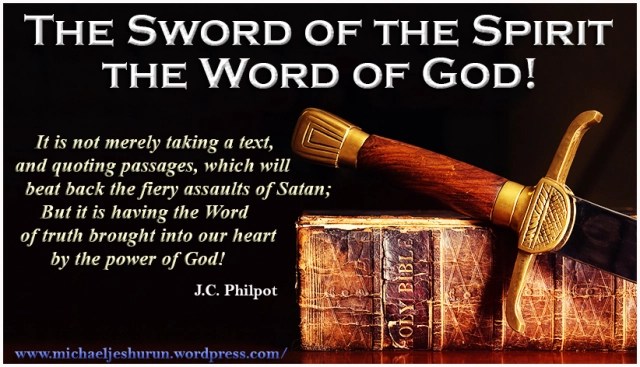
The Sword Of The Spirit In The New Year
All of us have made New Year resolutions, and all of us have broken them too. Many times our resolutions are abandoned before the sun goes down on January first. And I believe that very often we make New Year’s resolutions that have little to do with our spiritual well-being and our walk with God. Today I have been thinking about 2022 is year for spiritual growth. Let’s not call them resolution, because resolutions seem made to be broken. We’ll call them out spiritual goals for the new year.
Here are a few goals:
1. Read at least one chapter from the Bible every day.
It seems that when I read the Bible every day. I always find things I didn’t notice before. When we are looking when are looking for answers, we find new questions that we have never thought to ask. This is a good thing because we may find ourselves to deep deeper into the scriptures to find the answers and in the process find more questions. But every moment our minds are occupied in the way. God is working on us. And slowly but surely, the changes come. Ephesians 6:17 says that the sword of the spirit is the Word of God. The Bible is our weapon to defeat the lies of the devil. But how can we use it if we don’t know what it is? How will we know it if we don’t read it?
2. Pray for wisdom every day.
A lot of things we pray for, God says no, because we ask for things that will hurt us. But this is one thing we can be assured that He will say yes to, if we have faith.
If any of you lacks wisdom he should ask God, who gives generously to all without finding fault, and it will be given to him. But when he asked, he must believe and not doubt, because he who doubts is like a wave of the sea, blown and tossed by the wind. That man should not think he will receive anything from the Lord.
James 1:5-7
Wisdom is the key to si many of the good blessings God wants to give us in the new year
If we have wisdom, we won’t make bad decisions that gets us wi to trouble.
If we have wisdom, we won’t waste time and energy worrying about things we can’t change. If we have wisdom, we won’t say stupid and hurtful things that cause stress to ourselves or others.
If we have wisdom, we won’t bite off more than we can chew.
3. Look for an opportunity to help someone every day.
I truly believe that if we are looking for it, God will constantly send us people we can help. When we help people, we are sharing the love of Christ.
When we help people we are becoming more like Christ.
When we help people, we are helping to rid ourselves of the selfishness that steals our joy.
Here’s an example: a few weeks ago, I was busy doing errands in town. I was tired and just wanted to be done. I was stopped at a stop sign. I lady was walking behind me. As I pulled away from the stop sign she started running after my car. My first thought was to get away from this lady. Was she crazy? Why was she chasing my car, I then had an unction to stop and roll down my window. She said her friend was very ill and needed a ride to her house. So I told her to get in and we drove to her friend’s house. That day I was able to help her and her friend. If I hadn’t stopped. The lady’s friend would been in danger. Sometimes we are so busy thinking about ourselves, we don’t notice what other people are struggling with,
Some people have a saying “God helps those to help themselves.” I believe the more accurate saying would be, “God helps those who helps others,”
I tell you the truth, what they did for one of the least of these brothers in mine, you did for me.”
Matthew 25:40
There are always people who want to take advantage of our goodwill. And this takes up back to the previous goal. We must be wise. There’s a temptation just to stop helping altogether because there are so many scam artists. As Christians, we must be willing to help those who are truly in need. We just have to use our heads, and the wisdom that God gives us.
Look for the opportunity to help someone every day.
4. Say to yourself every morning. “Jesus could be coming back today.
We always know this in the back of you minds. I purpose that every day we force it to the front of our minds.
If we keep this truth before us every day, our priorities will be different. This is was Jesus said:
“Therefore keep watch because you do not know when the owner of the house will come back – whether in the evening, or at midnight, or when the rooster crows, or at dawn. (Mark 13:35)
Let us not forget that even if Jesus doesn’t return for another 100 years, we all have an appointment to meet Him much sooner than that.

