
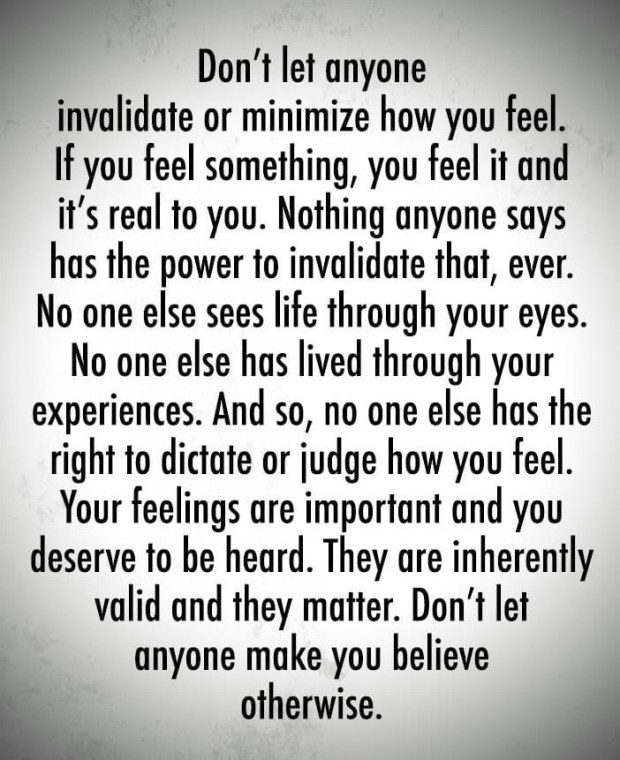
How To Speak Up For Yourself
Do you find it hard to speak up for yourself? Are you afraid of what might happen if you say how you really feel.
If you spent a lot of your life around unsafe people, at some point you probably decided that it’s better to stay silent about things that matter to you. In certain situations this is adaptive, but for most it isn’t
It is time to break your silence.
Practice identifying whether it’s wiser to speak up or stay silent.
If you, like me, tend to stuff your feelings and needs to avoid conflict or stay invisible. It’s a given that you need to speak up more.
Time, audience, tone of voice and truth.
When you identify that you need or want to say something, run it through these filters:
Is it a good time?
Will there be enough time to properly discuss it? Will you have the others person’s full attention? What kind of mood are they in?
Will this person listen?
Know your audience. I hope most people in your life will be willing to listen to you, and care about what you have to say. If not, you need to get some new people.
Sometimes difficult people are fixtures in our lives. This could be an insensitive boss, or a chronically unkind family member.
This type of person may have demonstrated repeatedly that they will not listen to you and don’t care. It’s generally unwise to express yourself to someone like this, unless the circumstances leave you no other option. Save your breath, you dignity and your emotional energy. A trained counselor can help you navigate this type of situation.
How can you speak, in order to be heard?
Tone of voice is key. If Your emotional, it’s best to wait for a better time. If you start getting upset during a difficult conversation, take time out and reengage when your calm. Work on speaking calmly and respectful, even if Your really angry and frustrated about something.
Sometimes the truth will suddenly come our during an emotional conversation, and that can be a good thing. It’s still more ideal to speak the truth while calm. Cultivate a tone of voice that helps you to be heard, respected and well received.
Know the truth
Before you speak up, get clear about what it is you need to say and why.
Pat attention why. Get clear about what is bothering you and why you need to speak up. Plan how you might express this effectively. Then choose your timing well.
Identify when you need to say no
Are you someone who needs to learn to say no? In a situation where you feel pressure to yes, but want to say no, clarify your why. You don’t have to tell the other person why. If you know why you have to say no. It will help you find the strength and the words.
Honor your emotions, notice that habit. What is the emotion you are avoiding or hiding? Practice identifying the truth of your emotions, and the way you hide them form others. What are you missing out on, because of this? How are you and your relationships suffering! When you are ready, if the situation is safe, start telling key people how you really feel.
Get wise help and support
As a I mentioned a good counselor can be very helpful with all of this. Together you can uncover and explore your most important truths, and the people you need to say thing to. They can help to formulate how and when to share these truths in real life. A wise friend or mentor can do the same thing.
If you’ve spend a lifetime pretending and hiding, it can feel really awkward and messy when you start to speak your truth. It’s still worth it.
It takes to much energy to hold all that truth inside.
What a relief it is to be real, when you find the courage and wisdom to do it.
Castle Gate Utah

Old Photo with train coming through the Gate.
Joes Valley Reservior

Realize The Power Of Your Own Thoughts
If I was to become aware of only one mental dynamic, the most important one to know about would be the relationship between your thinking and the way you feel.
It’s important to realize that you are constantly thinking. ( Don’t be fooled into believing that you are already aware of the fact.) Think, for a minute, about your breathing. Unless this minute, when you are reading this sentence, you had certainly lost the fact that you were doing it. The truth is, unless you are out of breath, you simply forget that it’s occurring.
Thinking works the same way. Because you’re always doing it, it’s easy to forget that it’s happening, and it becomes invisible to you. Unlike breathing, however, forgetting that you are thinking can cause some serious problems in your life, such as unhappiness, anger, inner conflicts, and stress. The reason this is true is that your thinking will always come back to you as a feeling: there is a point-to-point relationship.
Trying getting angry without having angry thoughts. Okay, now try feeling stressed out with out having stressful thoughts- or sad without sad thoughts- or jealous without thoughts of jealousy. You can’t do it- it’s impossible. The truth is, in order to experience a feeling, you must first have a thought that produces that feeling.
Unhappiness doesn’t and can exist on its own. Unhappiness is the feeling that accompanies negative thinking about your life. In the absence of that thinking, the unhappiness, or stress, or jealousy, can’t exist. There is nothing to hold your negative feelings in place other than your own thinking. The next time you’re feeling upset, notice your thinking- it will be negative, not your life. This simple awareness will be the first step in putting you back on the path toward happiness. It takes practice, but you can get to the point where you treat your negative thoughts in much the same way you would treat flies at a picnic: You shoo them away and get on with your day.
,
Why We Feel Good When We Do Wrong
Why do we feel good about ourselves even when we do wrong?
Unethical behavior is an action that falls outside of what is considered morally right or proper for a person. Individuals can behave unethically.
This can be:
Lying to your spouse about how much money you spent.
Lying to your parents about where you were for the evening.
Stealing money from the cash drawer at work.
Lying on your resume in order to get a job.
Talking about a friend behind their back.
Taking credit for work you did not do.
Cheating on paperwork by copying it off the internet.
Taking money out of your friend’s wallet when they are sleeping.
Selling a house and not disclosing known problems to the buyers
Using your position of power at worm sexually harass someone.
Selling a car and lying about the vehicles accident history.
Most of us want to believe that we are morally upright people who act according to a strong sense of right and wrong. But when faced with temptations to derive persona, benefit by violating moral principles, people do not always take the high road. Lying, cheating and other harmful acts are more common than we think.
Researchers call these self-serving justifications, they can take place making it easier to do it. Other times they help people or do kind things for people thinking it justifies their unethical ways.
Believing this behavior with benefits others. Such as stealing money from a cash drawer thinking you could help someone else that is suffering but taking half the cash for yourself. Framing it as a act of kindness. Instead of unethical.
The idea that a good deed outways the unethical deed. Good deeds don’t let you off the hook for the unethical one’s.
Admitting to unethical wrongdoings can be constructive but sometimes people admit only to one part of what happened, rather than fully owning up to the wrongdoing.
Demonizing those who have done worse.
Judging others harshly for the same offense you are doing.
Are You Exhausted From Trying To Be Stronger Than You Feel?
I saw a quote that said, I’m exhausted from trying to be stronger than I feel. And it really hit me. We live in a world that teaches things like fake it until you make it and love heals all wounds, but those little quotes don’t work for me. Pretending I was fine when people have wounded me did not work. People telling me to get over it, stop making such a big deal out of it. Didn’t help the pain I was in. It wasn’t until I realized what love really is that I was able to understand how love could heal my wounds. It wasn’t until I acknowledged where the exhaustion came from and how the wounds got there in the first place that I found my healing.
I was exhausted too. I was exhausted from trying to be happy and trying to be grateful for a life that seemed to be getting harder and harder. I was exhausted from being who other people wanted and expected me to be. I was exhausted from always trying harder and exhausted because nothing ever seemed to be enough.
I was exhausted because nobody heard me and because nobody cared that I was exhausted.
I just could not understand it. I believed that I might be the only person in the world that didn’t know how to make gratitude work for me. Even though I was practicing gratitude it wasn’t working. I felt defeated. I felt stifled. I felt oppressed. I was weary and just plain tired to the bone.
I had nothing to feel unhappy about and I felt guilty and ashamed of myself. I believed I was living the dream: a good husband, two amazing children, living in a big house, the best dog in the world.
But I wasn’t happy I was exhausted. At 35 years old I was heading to major depression. I was doing my best to keep my family happy, raising my children to be successful adults. I was getting outside every day. I was reading self-help books but I kept falling down and getting back up.
I had been trying to be stronger than I felt most of my life. Trying to be grateful, trying to let go and move on, trying to live and let live, trying to be me.
Trying to forgive and forget people that denied they had ever done anything wrong. Trying to accept the blame for things that we’re never my fault, never my responsibility or my doing.
I was completely exhausted from trying.
Today I live with peace and harmony. I haven’t been depressed in over 15 years. I am excited to get up in the morning to see what God has planned for me, and the blessings I will have.
My children are adults and successful in their lives. I belong to some great organizations, and able to bless someone every day. Helping people makes me happy. I enjoy seeing others happy and full of life.
So what happened? How did I get from being exhausted to excited? I build the missing bridge with God’s help.
I had to build my self-esteem, I had to learn to let go and move forward. I had to burn the roots to my brokenness. I had to look at the cold truth defined by my actions and the inactions of others.
I realized that I had been objected to a very small age and what had been communicated to me through the careless action and inactions of people. And that I had a purpose in life to help others be the best they could be, to be there for them to help strengthen them and pray, for them. To serve the needs of others. My actual needs we’re invalidated. I was brainwashed to see myself as not enough, now worthy, no lovable because seeing myself that way was enabling people to control and manipulate me to get what they wanted from me. I was exhausted because I was taught what to do what everyone else wanted and not what I wanted. I kept trying harder and harder and it was never enough. I was exhausted from trying to prove that I was worthy and I was a good person. I felt like my heart was misunderstood, I was brainwashed to also believe that something was wrong with me.
I found a way to look what happened to me. How did the depression start? My depression was a way to shut down. My way of coping. After years of my way of coping. I ran out of energy to keep trying. I gave up on the fact that I didn’t believe there was anyway to achieve anything in my life.
But there is a way. There is hope, and I found success. I found a new way to see myself. I found a new way to see my struggles and finally said: no wonder I was depressed. No wonder I was sinking. No wonder I felt like I was losing the fight.
As long as I saw myself the way that I’d been brainwashed to see myself, I was losing the fight. I saw through the grid of the truth about me was when I came to believe that I was not enough, something was wrong with me, I was powerless and had no choice.
We are all worthy and we are all enough.
I took my power back. I took my life back and got me back.
I have the energy to spare today and I am free of the oppression that held me back for so very long.
Spirituality
Spirituality does not come from Religion it comes from your soul. We must stop confusing religion and spirituality. Religion is a set of rules, regulations, and rituals created by humans that were supposed to help people spiritually, due to human imperfection. Religion has become corrupt, politically divisive, and a tool for power struggles. Spirituality is not theology or ideology. It is simply a way of life. Pure and original as given by the God of the universe, and each other.
One More Passing Show
There is a strategy I have adopted in my life. It’s a subtle reminder that everything- the good and bad, pleasure and pain, approval and disapproval, achievements and mistakes, fame and shame they all come and go. Everything has a beginning and an ending and that’s the way it’s supposed to be.
Every experience you have ever had in your life is over. Every thought you’ve ever had started and finished. Every emotion and mood you’ve experienced has been replaced by another. You’ve been happy, sad, jealous, depressed, angry, in love, shamed, proud, and every other conceivable human feeling. Where did all that go? The answer is no one ever really knows. All we know is that, eventually, everything disappears into nothingness. Welcoming this truth into your life is the beginning of a liberating adventure.
Our disappointment comes about in essentially two ways. When we are experiencing pleasure we want it to last forever. It never does. Or, when we’re experiencing pain, we want it to go away-Now. It usually doesn’t. Unhappiness is the result of struggling against the natural flow of experience.
It’s enormously helpful to experience the awareness that life is just one thing after another. One moment is followed by another. When something is happening that we enjoy, know that while it’s wonderful to experience the happiness it brings, it will eventually be replaced by something else, a different type of moment. If that’s okay with you, you’ll feel peace even when the moment changes. And if you’re experiencing some type of pain or displeasure, know that this too will pass. Keeping this awareness close to your heart is a wonderful way to maintain your pleasure, even in the face of adversity. It’s not always easy, but it is usually helpful.

What Do We Need To Know About God?
God loves us and wants a personal relationship with Him.
God loves us even if we haven’t loved him.
In this love, not that we loved God, but that He loved us.
1 John 4:10
God wants us to know Him. The Bible says God is at work in everyone’s life. So that they should seem the Lord, in the hope that they might grope for Him and find Him, though He is not far from each one of us. (Acts 17:27)
What is Wrong With Us?
Our relationship with God has been broken by sin.
We have all made choices showing we are inclined to be passively indifferent to God.
All we like sheep have gone astray; we have turned, everyone, to his own way; and the Lord has laid on Him the iniquity of us all. (Isaiah 53:6)
Or actively opposed to God
And this is the condemnation, that the light has come into the world, and men love darkness rather than light unless his deeds should be exposed. (John 3:29-20)
The result of our choices to resist or ignore God results in spiritual death ( separation from God).
We are dead in trespasses and sins. (Ephesians 2:1)
And this death spreads to all men because all sinned. (Romans 5:12)
What Did God Do For Us?
God had provided a solution for our lost relationship.
Jesus came to do what we could not do for ourselves.
For God so loved the world that he gave His only begotten son, that whoever believes in Him should not perish but have everlasting life through me. (John 3:16)
He came. Into the world to bring us to his Father.
Jesus said I am the way, the truth, and the life. No one comes to the Father except through me. (John 14:6)
I’ve died in our place to pay the penalty for our sin.
For Christ also suffered once for sins, the just for the unjust, that He might bring us to God, being put to death in the flesh but made alive by the spirit. (1 Peter 3:18)
He rose from the dead to show that his claims were true.
For I delivered to you first all that which I also received: that Christ died for our sins according to the Scriptures and that he was buried, and that He rose again the third day.
What Do We Need To Do?
We must each personally trust Jesus as our Lord and Savior.
Our own efforts to earn God’s acceptance are inadequate.
Not by works of righteousness which we have done, but according to His mercy He saved us, through the washing of regeneration and renewing of the Holy Spirit. (Titus 3:5)
We must admit our need for forgiveness. For all, have sinned and fall short of the Glory of God. (Romans 3:23)
And the tax collector, standing far off, would not so much as lift his eyes to heaven, but beat his breast, saying God be merciful to me a sinner. ( Luke 18:13)
We must receive Christ and his offer of salvation as a gift.
But as many as received Him, to them He gave us the right to become children of God, to those who believe in His Name. (John 1:12)
For by grace you have been saved through faith and not of yourselves; it is the gift of God, not of works, lest anyone should boast. Give all Glory to God. (Ephesians 2:8-9)
Where Do We Begin?
You can begin your personal relationship with God by putting your faith in Jesus as your Savior and Lord. You may find it helpful to express your new faith in words similar to these:
Dear God, I know that my son has separated me from You. Thank You for sending Your Son to die in my place. I now trust Jesus to forgive my sins. I invite Him into my life as my Savior and Lord: Thank You for receiving me into Your eternal family. In Jesus Name, Amen.
What’s Next?
Your trust in Jesus begins everlasting relationship with God.
God promises to never leave you or forsake you. ( Hebrews 13:5)
God has given you His Spirit to enable you to live in a way that pleases Him. If we live in the Spirit, let us also walk in the Spirit. (Galatians 5:25)
Deception Through Lies
How many of us have fell for lies someone has told us. I don’t know about you but, I heard a million lies in my life.
Lies, Legalism and superstition, and curses all work to bind us into certain behaviors and keep us from the liberation keeps us trapped and keeps us from God. Each of these work against your thinking process. The minute you receive them as truth, even though they are a lie, you have been captured by a demon force. All of us can be demonized. Even if your the most honest person on earth.
Even people following God. The lies that people are receiving perverts their ability to think or receive truth in their minds. It calls good evil and evil good.
If a person ever begins to believe a lie, the lie will go into their mind and end up in the heart. Proverbs 4:23 says above all else, guard your heart, for it is the issues of life. A lie will go down into the issues of life that are in his or her heart and try to prevent the life process that he or she has been sent into this world to accomplish. Whatever we believe a lie. It actually interrupts the life cycle.
Instead of flowing through your blood, here come the lying words and that actually starts flowing through the veins of our body. As the lies start flowing through the blood pumping through our heart (which is accepted the lie), it begins to darken our conscience. Satan knows that control your conscience that is darkened enough to trap you. So as this flows through your body it begins a stronghold and a wall to keep the truth from coming to you.
Every lie we receive in our minds works like an anesthetic to deaden us. In the Bible, it is called a spirit of slumber. How it works is to go to sleep at the right time to attach into the unbelieving, mocking, blasphemous spirit so that you can’t see the truth and be liberated. It will make you go to sleep at the right time to keep you from hearing the truth. Satan will try to use false arguments and philosophy to begin to exalt himself in your mind above the knowledge of God. So we are to cast down these things.
 From Pity to Praise