Have we lost our sense of awe, reverence, and fear of God by replacing it with overfamiliarity, casual worship and spiritual indifference? Many view God as a primary loving friend rather than the Holy Creater.
I believe we have lost our sense of wonder and amazement at things God has said and come on our behalf. Without it, chaos, deception, and God’s judgment are inevitable.
Restoring the awe of God involves intentionally slowing down to recognize His majesty through nature, scripture, and consistent worship (praying without ceasing).
Our modern views are often  prioritized over God’s love, mercy, and comfort, while neglecting His power, majesty, and righteous wrath. We have the tendency to be satisfied with the benefits of salvation without cultivating a deep, trembling wonder of the cost and Majesty of God. 
In Rabbi Jonathan Cahn’s book “The Return of the Gods” argues that when a society or individual removes God from their life, culture, or government, it creates a spiritual void that inevitably invites the return of ancient pagan spirits. He argues that “if God is pushed out, there is always something ready to take His place.” The removal of prayer, scripture, and Biblical values from life acts like an open door for these entities. As God is removed, the void that is left is filled with idols of materialism, pleasure, and self worship.
How much does God’s Word shape your life? How much does the Bible get in the way of what you believe?
Most people who believe in Jesus, compartmentalize their faith so that their Bible beliefs have only a little influence over other areas in their lives. And for some, the Bible doesn’t influence what they believe one iota.
As long as they claim to believe in Jesus, they think they can believe whatever they want about issues in life and society.
Today churches’ goals are at large is to basically “Let’s just get people born again and make sure they’re headed to heaven” I was never just okay with that, I wanted to learn how to live a godly life, not just be saved and hope for the best. Churches that lead this way cause people problems along the way.
Many churches aren’t teaching people to observe all the things Jesus commanded. I believe there’s a void in society where believers ought to be taking a stand.
When it comes to social, and moral issues, a lot of believers are silent or they oppose what the Bible says. They profess faith in God, but don’t live by His statutes.
It’s not enough just to get saved so we won’t go to hell. It’s not about an insurance policy. It’s about being a disciple. That should be the goal of every believer.
It’s amazing to me how many people don’t get this. They think the Bible shouldn’t influence what they think about economics, racial issues, marriage, or health. When it comes to hot topics like homosexuality, abortion, and evolution, the church is divided. Most would say, “See, now you’ve gone to meddling. Leaders just need to stick to preaching the Word and stop getting into politics and social issues. But most church members don’t realize that the Bible -God’s Word was into politics and social issues. The Word of God has instruction for every one of these areas.
The Word of God has a lot to say about the issues we face in society today. Unbelievers -who don’t have a biblical overview are the ones that are going to be establishing all of the policies, determining what we can say and what we can’t, what we can do and what we can’t do. If believers remain silent.
Many believer have already accepted the way of the non-believers. They have already moved away from the words of Jesus. They don’t know what the Word of God had to say on all of these things.
Too many people today say, “I love Jesus, but really don’t love the Word.” That’s how we become deceived. If our attitude and our worldview doesn’t line up with the Word of God, something needs to change.
If the church (and we) don’t stand up and say what is right and preach the Word of God, then the views of the world will be forced on us. While it’s great to be inclusive and make people feel welcome to come to our churches, we are not doing them any favors by not speaking the truth.
“Let love be without hypocrisy. Abhor that which is evil. Cling to that which is good” -Romans 12:9
Gunnison River in Black Canyon National Park -Colorado
Until we take time to be quiet, we will not hear God. God cannot be heard in noise and restlessness, only in silence. He will speak to us if we give Him a chance, and listen. Psalm 46:10 states, “Be still and know that I am God.”
God speaks to the spiritually thirsty and hungry in Isaiah 55:2-3,
“Why do you spend money for that which is not bread, and your labor for that which doesn’t satisfy? Listen diligently to me, and eat that which is good, and let your soul delight itself in richness.
“Turn your ear, and come to me. Hear, and your soul will live, and I will make an everlasting covenant with you.”
Listen! There is no other way to take Him in. Jeremiah said in 15:16,
“Your words were found, and I ate them. Your words were to me a joy and the rejoicing of my heart, for I am called by your name, the Lord, God of Hosts.”
The problem with many of us is that even though we read God’s Word, we are not feeding on Him. We are more intent on mastering the text and finding our it precise meaning, gathering theories and theologies, so we can talk more intelligently about God. But the main purpose of reading the Bible, is not to accumulate data about Him, but to come to Him, to encounter Him as our living God.
In John 5:39, Jesus told the best read religious leaders,
“You search the scriptures, for in them you think you have eternal life, and these are they which testify of Me.”
In other words, the religious leaders diligently studied the scriptures, believing they finally eternal life within them, yet they missed the scriptures that they are witness to Him.
The scholars read the Bible, but they didn’t listen to God, they never heard His voice. We should do more than read words, we should seek the Word exposed in the words. We want to move beyond information to seeing God and being informed and shaped by His truth.
There is a passing exhilaration in discovering and acquiring knowledge about the Bible, but there’s no life in it. The Bible is not an end in itself, but a stimulus you are in your action with God.
We read God’s Word, but we’re not feeding on it. The Bible is the mind of the Lord. When we read His Word, we are reading His mind – what He knows, what He feels, what He wants, what He enjoys, what He desires, what He loves, what He hates.
“For who has known the mind of the Lord, that He should instruct Him? But we have Christ’s mind” -Corinthians 2:16
Take the time to reflect in what He is saying. Think about His words. Give yourself time to pray until God’s heart is revealed and your heart is exposed.
Listen carefully to the words that touch your emotions and meditate on God’s goodness.
So much depends on our conscious desire to engage Him in a personal way.
Remember, it’s not how much time we spend at first. The important thing is to make an effort each day. The Holy Spirit lets us know where to go from there.
God has no limits to His love. We can come with all our doubts, disappointments, and mid judgements. God is someone whom we can approach without fear. Someone whom we can submit ourselves to without despair.
Have you ever noticed how life acts as a mirror for what we most deeply desire? Or what we most deeply fear?
Perhaps this is due to the fact that our desires both )conscious and unconscious) set up a story lens of expectation through which we view the world and filter the information presented to us. In expecting or avoiding things, we are actually making ourselves more conscious of them with the overall effect of creating the very circumstances through which they will occur.
Or maybe as science would tell us that our beliefs command molecules of life which in turn configure themselves around our thoughts, feeling, and experiences that we believe.
I think this phenomenon is known as story making. We are presented with a series of choices in our lives that are the direct result of the stories, beliefs, and dreams that we create in our imaginations. Whether we are aware of them or not.
Our choices determine our actions which in turn determine our reality and experiences. So how do we move from unconscious story makers experiencing repeated patterns of behavior and events to becoming the conscious writers of stories that we truly wish to live?
Maybe we need to begin by becoming aware that the world and its seemingly outer events are one great big mirror to the inner story of our soul. I think God gives us messages in different ways. Those messages that send chills down our arms, or as I like to call them, the aha moments.
It’s like God mirrors back to us clues that point to an important story-making point that we are invited to take.
The real trick is to learn to spot the clues as they are happening so that we can develop up a greater ability to know whether we are on or off track towards the destiny of our deeper story. The greater gift is to know when to act on these many miracles to create increasing momentum and magic in our lives. I have found that the moment when I awaken to one of my personal clues, I receive what I have come to call cellular shivers that touch my soul. And give me the realization that I have just been given an important piece of the puzzle of my story.
The clues that we are given in life gives us experiences to allow us to look into the magic soul mirror. One that shows us our conscious and not so conscious beliefs and stories.
This takes practice and determination. It takes courage and bravery to reclaim complete power to choose and create our soul story. It asks us to slow down, pay attention and practice story making a deeper and deeper levels.
I honestly hope I don’t live until I’m 100. The older we grow the more physical problems we have to endure. And sitting around all day and relying on others to help me isn’t my bag of tea.
If we want to start seeing the power of God, manifest in our lives, we will have to start paying attention to what we say. Words have power – more than any of us realize, but we often speak to them as though they are meaningless. Because of that most believers at one time or another have been hung by their tongue.
Matthew 12:36-37 says, “But I say unto you, that every idle word that men shall speak, they shall give account thereof in the day of judgment. For by your words you will be condemned.”
“Every idle word” simply means nonproductive. These are words that you speak, but don’t believe. For example, I might say, “I’m dying to see my children.” I really don’t mean I’m dying, but I say it anyway to emphasize the importance of it.
Every time we say things, we don’t really mean, it begins to numb our hearts. Unconsciously, each idle word is making it just a little bit harder to believe what we say is actually going to come to pass when we mean it it really counts.
Jesus certainly understood the power of words, and He used them to change the natural things around Him.
Mark 11:13-14 talks about the fig tree, “And seeing from afar a fig tree having leaves. He went to see if perhaps He would find something on it. When He came to it, He found nothing but leaves, for it was not the season for figs, in response Jesus said to it, “Let no one eat fruit from you ever again.”
When He and His disciples passed by the next morning, they saw the fig tree had dried up from the roots. Peter remembering, said to Jesus, the fig tree which you cursed has weathered away. Jesus replied and said, “have faith in God. “I say to you, whoever says to this mountain, be removed and cast into the sea, and does not doubt in his heart, but believes that those things he says will be done, he will have whatever he says.
Jesus was probably amazed by Peter’s unbelief. He might have been thinking “It shouldn’t shock you to see this tree withered, “Have faith in God.”
Then Jesus went on to explain that it wasn’t limited to the fig tree. He used a mountain as an example, but I believe it could apply to anything. Jesus was making the point that if we say it with our mouths and believe it with our hearts, we can have what we say.
Jesus used the word “say” three times in Mark 11: 23 making it clear that words have power. But He also said, “have faith in God.“ the words that have power are the words that are filled with faith. It’s important to understand that faith that we are filled with isn’t human faith. 
Galatians 2:20 says, “I have been crucified with Christ, and it is no longer I that live, but Christ lives in me. That life which I now live in the flesh, I live by faith in the Son of God, who loved me, and gave Himself up for me.”
When I studied this out, it became very clear that it is talking about the faith of God that He placed in us when we were are born again. We cannot even be born again if we don’t have faith. Roman’s 10:17 says, “So faith comes by hearing, and hearing by the word of God.” and 1 Peter 1:23 says, “who through Him are believers in God, who raised Him from the dead, and gave Himself up glory, so that your faith and hope might be in God.”
If we can’t even believe for salvation with our human faith, how could we possibly use it for other things like healing and prosperity? It’s important to understand this. If we don’t know this, we will always be looking for others to pray for us. We always think that they have more faith than us, and because of that, God will act on our behalf when they pray. That’s wrong and it’s the reason many believers are working to man instead of God for their answers.
Romans 12:3 says, “For I say through the grace that was given me, to every man who is among you, not to think of himself ore highly than he ought to think, but to think reasonably, as God has apportioned to each person a measure of faith.”
Think of this like using a ladle to dish soup. If we use the same ladle every time – and God did, every person will get the same amount of soup. It’s the measure of soup. We have a measure of faith, no born again believer has more faith than any other, some just do a better job appropriating what they have been given.
Hebrews 11:1 says, “Now faith is assurance of things hoped for, not seen.” And verse 3 says, By faith, we understand that the universe has been framed by the Word of God, so that what is seen has not been made out of things that are visible.”
This scripture is not symbolic, God actually created everything with words. He spoke creation into existence, and the substance of His faith manifested into what we can now see. The word of God has unlimited power. Each word is like a little capsule, filled with faith, waiting for us as believers to release it in our hearts and speak it with our mouths.
Everything we see was created by words, and it is a very Word of God that holds the universe together. Therefore, everything we see will respond to faith filled words. They have to respond because words are the parent force.
Proverbs 23:7 says, “that as you think in your heart, so are you.” And Luke 6:45 says, “The good man out of the good treasure of his heart brings out that which is good, and the evil man out of that which is evil, for out of the abundance of the heart, his mouth speaks.”
If we understand that our words have power, then we’ll understand why we can be hung by our tongue.
The only reason every one of us isn’t dead from the many Idol words we have spoken is because we haven’t believed every word with our hearts. This should help us see a powerful truth. If we believe we are going to be sick we believe that we are always going to be poor, and then confess that with our mouths., we will get what we believe in our hearts.
What happens when we take the faith filled words of God and plant them in our hearts where they can root and grow? Everything changes -no longer are we just saying, “I believe I am healed” or I am prosperous,” but we believe it and the faith of God is then released through those words.
When I was diagnosed with bladder cancer, and given one year to live. I believe in my heart that the doctor was right. But then I started believing that God wouldn’t give me a death sentence. That I would be healed. I studied every day, prayer every day and even had elders of the church pray for me. I began to believe in my heart that I was healed. That was 12 years ago.
Proverbs 18:21 says, “Death and life are in the power of the tongue, and they that love it shall eat the fruit thereof.”
It not only says life, but death as well. It’s sad to say, but most of the words being communicated today are negative words, words that do not bring about abundant life cause more problems.
My middle name is Elizabeth. I was named after my Nagymama (grandma). The meaning is very significant because the meaning is “God is my oath.” Many say, a name is just a name, but it is so much more, like serving as a repository for family history, cultural identity, and personal reputation. Names embody things like integrity and strength, legacies Legacies and social perceptions.
There is a lot of trouble that starts with our mouths. Our words either kill or give life, they’re either poison or fruit and we get to choose.
Proverb 18:21 tells us, “Death and life are in the power of the tongue, those who love it will eat its fruit.” Our greatest enemy is not our home, job, or even that person who gets on our very last nerve, our greatest enemy is our mouth and what comes out of it. That 3-inch muscle in our mouths has more power to destroy our lives, and to do it more quickly, than anything or anyone else.
We’ve caused wounds in others’ lives, and we’ve received wounds ourselves. The wounds of my mother, by her words destroyed my life for nearly 35 years. At the same time, I nearly destroyed my own life with my own words. Saying things to others that I cannot undo, I cannot take back.
Is it any wonder that God tells us about our mouths in Proverbs 10:11, “The mouth of the righteous is a spring of life, but violence covers the mouth of the wicked.”
Our mouths can either heal us or kill us. One of the most powerful tools in our possession for good and evil is words. With our words, we have the power to kill or the power to heal. Our tongues isn’t just our greatest enemy, it can also be our greatest asset.
If we look through the book of Proverbs, there are several examples of murdering words, words that deceive, words that gossip, and words of anger.
Lies murder trust, thereby killing the thing we long for most in the world, relationship. Proverbs 6:16-19, declares, that the Lord hates 6 things, in fact 7 are detestable to Him, arrogant eyes, a lying tongue, hands that shed innocent blood, a heart that plots wicked schemes, feet eager to run to evil, and one who stirs up trouble among brothers.
Two of the seven are words that deceive, right up there with murder. The world cannot function without some measure of trust. No relationship can exist without trust. Trust takes years to build, but only seconds to destroy.
Words that gossip are similar. Few things can destroy any group of people faster than gossip because it kills friendships, families, offices, and schools. It’s important that we to avoid people with a big mouth. If they are gossiping about someone around you, they are surely gossiping about you to them. We can gossip by speaking or listening. Don’t say it, and don’t listen to it. It’s kind of like passing around a loaded gun, it’s not worth it. Gossip is death,
We know the damage that can be done with words spoken in anger. Proverbs 22:10 tells us, “Drive out the mocker, and strife will go out, yes, quarrels and insults will stop.” Proverbs 15:4 also says, “The tongue that heals is a tree of life, but a devious tongue breaks the spirit.”
Yet, some talk to others like we’re the star of our own daytime talk show. We may call entertainment or passion, but the angry voices we listen to shape us to speak like them.
The tongue can also be a great force for good. We have the power to give life in our mouths. A person who says just the right thing at just the right time, and we almost feel like a different person, or when you start speaking, and we see someone’s eyes light up, and we know we made a difference.
The best words begin with silence, if we want to give life with our tongue, we can begin by listening.
“In the multitude of words there is no lack of disobedience, but he who restrains his lips does so wisely” -Proverbs 10:19
“There is one who speaks rashly, like a piercing sword, but the tongue of the wise brings healing” -Proverbs 12:18
“The heart of the righteous weighs answers, but the mouth of the wicked gushes out evil” -Proverbs 15:28
“Do you see a man who is hasty in his words? There is more hope for a fool than for him” -Proverbs 29:20
How much heartache could be avoided if we listened? Instead, while others talk, we’re busy reloading. We crowd others out with the sound of our own voice. Sometimes the best thing we can say to another person is to not say anything at all. Our lips need breaks. If wecesnt to learn the language of any relationship, we start by listening.
When we speak we should, lean in with grace.
“Gracious words are like a honeycomb, sweet to the soul and healing to the bones” -Proverbs 16:24
Our words can speak positively to others. Jesus died for us all so our failures don’t define who we are. Remember everyone you meet is fighting a battle. When we speak gracious words of encouragement and love, they can fight a little longer.
We have the power of life and death in our mouths. Choose wisely
I learned something that is a bit of useless information, but I found it interesting. The term narcissist originates from the Greek myth of Narcissus, a stunningly beautiful hunter and son of a river god and nymph, who was cursed by the goddess Nemesis to fall in love with his own reflection in a pool. He became obsessed with his own image, unable to leave, and eventually withered away.
In his demise, he was unable to possess his own reflection, Narcissus died of obsession and sorrow. In his place grew the Narcissus flower, often found blooming near water.
Sigmund Freud incorporated the Greek myth of Narcissus into psychoanalytic theory to define narcissism as a libidinal investment in the ego rather than in external objects.
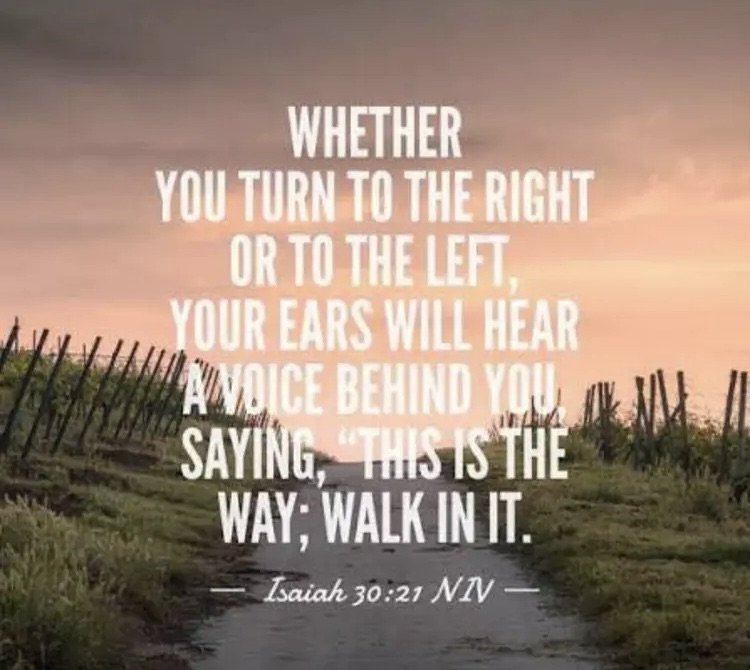
“When you turn to the right hand, and when you turn to the left, your ears will hear a voice behind you, saying, ‘this is the way. Walk in it” -Isaiah 30:21
Isaiah 30:22 assures us as believers that God provides direction for our path, offering correction and leading when we are unsure.
God can guide us while we are moving or acting, rather than just waiting for direction.
Hearing that voice behind us can suggest a quiet, inner, or gentle nudge rather than just a command.
God promises guidance when we turn to the right or left, when we veer off the wrong path. Have you ever felt that check in your spirit, that feeling when something seems off? That’s God -The Holy Spirit guiding you.
The ability to hear His voice is linked to a close relationship with God, rather than being exclusive to a “spiritual elite.”
















 From Pity to Praise