
Inspiration For Change
Ways to help rediscover your inspiration to make lasting changes.
Most of us have a,ready forgotten about the resolutions we made for the new year. The easiest thing to do would be to just forget about it until next year, right? Maybe not.
It’s only the month of may and it’s not to late to tap back into that sense of inspiration you had back in January. And it’s not to late to are your desired changes or at least explore what got in your way of the new habits you were going to make.
Here are a few ways you can explore your specific situation and how you can use these reflections to learn and grow any time of the year.
Clarify Your Why
Why did you select the goals you did for this year? Why were they important to you? Changing a habit is hard. Changes that stick do so because the reason behind them is stronger that the urges to engage in your old habits.
Here Are A Few Prompts:
- Write down what your life will look like if you put your new habits in place.
Be as detailed as possible and include the emotions you and others around you may feel.
- Write down what your life will look like if you don’t
Again, use as many meaningful details as possible, including the emotional experiences.
- Ask yourself how important it is for you to make the desired changes on a scale of 1-10 with 10 being the most.
If your rating is a one, you probably don’t have good enough reasons for this change. So, let it go. You have better things to worry about.
But if your rating is greater than a one, list your reasons for why your rating is
greater than one. Why isn’t it just a one? Write down why any change is important and in what ways you are ready. Make this list as personally meaningful and detailed as possible. Put it some place convenient so you can reference it down the road.
- For Example, say my goal in the new year was to pay attention to my diet and add more fruits and vegetables and fewer processed and refined foods, if I were to imagine what my life would look like with these changes. I like to imagine myself being able to walk with my kids 2 miles to the beach without getting tired.
When I imagine what my future might look like without these changes, I imagine myself dying without seeing my grandchildren born. I imagine my kids wishing they had there mom to help them with their babies.
With this In mind, the importance of this change is clear. I would put at least an 8 on the scale of 1-10. And the reason why it is so high is that I love my kids and want to continue being there for them. I don’t want to burden them financially or emotionally in ways that I have the power to avoid.
I also want to wake up every morning and have energy to enjoy every minute of life I have. I keep my list by my bed and look at it every morning before starting my day.
Understand Your Cravings
Craving is at the root of all suffering. Craving takes on many forms: we crave a new outfit, a new job, or for a habit to become easier. Cravings are quite uncomfortable, and we soothe this discomfort with some action, usually with behavior that distracts us from feeling and provides temporary pleasure. This craving doesn’t map onto the craving at all.
It’s like going shopping for that new outfit and trying on clothing that you know would look better if you lost 20 pounds. Or craving that new job but instead of taking night classes to up your chances of getting that new job. You go to the club after work and drink just to forget about the job you currently have. It works out temporarily but it does not get rid of the craving of what you really want. Unfortunately we seem to repeat bad behaviors or cravings. Not only does it become more hardwired in to our brains the root craving also persists,
So when we decide to head to the freezer for a second serving of ice cream to set us up for more sugar cravings or the the bar after work for drinks, to hide how we really feel about that job. We also don’t make any meaningful changes needed to satisfy the real craving inside.
To break free or this cycling we need to understand it. To do this we need to slow down and observe what is happening in our bodies and minds when craving an old undesirable habit.
We need to recognize what are thoughts and feelings that come up. Sit and notice the sensations with full attention and curiosity. You will notice that when you do the urge of of engaging in the old habit passes in a wave. Do you do this a for several days you will likely discover that you can be with the feelings and urges with have to act on them.
To take this one step further see if you can identify the real need behind the urge. Are you bored? Tired? Thirsty? Needing a physical or emotional connection.
Sometimes our goals falter not because we don’t have good reasons to change, but because we think we don’t deserve better. We tend to judge ourselves harshly for our failures.
Explore what gets in the way of the changes you want to make with curiosity rather than judgement. What happened before or after the behavior you wanted to change? Are there identifying triggers?
Doe’s Feeding In A Field

Balance Rock In Helper Utah – Taken By A Photographer

Keeping A Positive Mindset
How To Keep A Positive Mindset No Matter What
Do you ever find yourself stuck in negative thinking, entertaining what Congo wrong, or mulling over sad memories? What things do you do to keep a positive mindset?
Chances are, you’ve probably had someone tell you to “Cheer up” or “look on the bright side.” And while there’s no doubt they can mean well, it can be difficult to keep a positive mindset all the time.
Cultivating a happy mindset puts you in the right mood to compound your happiness with happiness-boosting behaviors. To focus on ways to keep a positive mindset, we need to focus on ways to become cheerful, content, and pleasant toward others: finding reasons to laugh, practicing being polite, searching for the positive in situations and finding a way to escape mentally.
Here are some simply ways to keep a positive mindset and focus more on joy instead of negativity.
1. Find Reasons To Laugh
Laughter has the obvious side effects of making you happy, along with lowering your blood pressure and stress levels, helping ease conflicts, and strengthening social bonds with others. What’s less obvious is that your laughter goes a long way toward making others happy. There are several ways to come up with more occasions to laugh.
- Indulge in others attempts to make you laugh. This makes them feel good, as we all enjoy being the one to make another laugh, and it helps diminish our self-centered tendencies by forcing us to really listen to what others are saying.
- Force laughter if you have to – such as when a child is telling you a joke for the 20th time. This will delight them and their emotions will be bounced back to you, so your forced laughter may very quickly become real,
- Take yourself less seriously and be willing to laugh at yourself more. This often has a cheering effect that dissipates the stress of the situation, while defensiveness makes you ruminate on negative feelings. For example, if your like me, I tend to put things in stupid places. I’ve put the remote to the tv in the refrigerator. I sometimes inadvertently take the remote with me to get a snack and sit the remote down to get to what I want. Then spend the next 30- minutes looking for the remote. Instead of getting stress and upset or getting mad at myself because I can’t find the remote, I find ifI just laugh at myself “WoW I did it again.”
2. Practice Politeness
To be come more pleasant and kind toward others, focus on practicing good manners and conscientiousness. In our busy lives, we often skip over politeness because we’re too caught up in our own stresses. To work against this, be on the lookout for small ways to be considerate of others – such as giving up your seat on the bus, or letting someone with only a few items at the grocery store cut in front of you, when you have a cart full. Or offer to help a elderly person with their groceries or return their shopping cart for them. I only takes a few minutes a day to bless someone.
3. Be A Better Conversation Partner
I admit this is one I struggle with this one. Recently I went to a concert with a friend. While standing in line she struck up a conversation with a stranger. By the time we were at the end of the line she knew all about them. I struggle with talking to people I’ve don’t know. It may be because of my social skills (being I didn’t learn any as a child). But it is something I need to work on.
One place that many people are guilty or bad manners is in conversation. While speaking to someone listen carefully and make sure that you’re not coming off as rude.
- One-uppers always respond to the speaker with a better or more extreme in their own lives. Like, “ Oh you think that’s painful? Listen to what happened to me a few months ago.”
- Know it-all’s hijack the conversation to demonstrate how much they know about the subject at hand. Like, Did you know that in that region you visited in France is the only one where they speak Ch’ti?”
- Interrupters cut off others in the middle of their sentences to ask questions or respond. This happens to me a lot because I think before I speak and people think I’m finished talking.
- Non-listeners don’t actually listen to people they’re speaking to – instead, they’re thinking about the next thing they want to add to the conversation.
Beyond cutting out our bad conversation manners, we need to find ways to give the floor to others. You might respond to someone’s expertise with, “That’s interesting tell me more.” Or, follow up your addition to the conversation with, “What do you think about it?’
Pinpoint What Makes You Rude
Keeping an eye out for external factors that might be making you act rudely. For example I have a friend that when she drinks more than 3 alcoholic beverages she gets argumentative and obnoxious, and she regrets coming away from get togethers instead of feeling happy. So she decided to cut back her drinking when she’s out. For you it might be that the music is to loud or even being to hot or cold. (I know when I get cold I get irritated and seem to lash out at people for no reason). Once you find out what prompts your rude tendencies, find a way to mitigate it such as always having a sweater.
4. Search For The Positive
Many people instinctively prefer to be critical, rather than enthusiastic, about things – for several self-serving abs defensive reasons.
- Being critical feels and is often perceived as a trait of sophistication or intelligence.
- It’s very easy. Being critical of or detached from something, such as reality television or a cheesy band, is much easier that leaning into your enthusiasm for it.
While expressing enthusiasm might be the harder and more unpopular choice, it comes with the benefit of lifting others’ moods and making them feel more enthusiastic as well. Imagine that your friend invites a group out to see a college concert, she loves singing, but you find it boring, you don’t want to hurt your friends feeling so you go. She wants you to participate in singing along. and you end up singing along and actually enjoy the concert.
There are three ways to commit yourself to searching for the positive and expressing enthusiasm as much as possible.
- Look for ways to be positive about everything, even the things you don’t like. For example, when you’re trying a new food don’t say “This had to worst taste and texture.” Instead try it, it might be fun trying something new.
- Try to deliver criticism in a more positive way. Instead of telling your child, “Stop playing that recorder, you’re driving me nuts,” try you’ve practiced your recorder so much today. I think you deserve a break.”
- Create a reminder to stick to positive comments. My friend complains about the same thing everyday. Every time she brings this subject up, I’m going to give her a compliment.
4. Find A Mental Escape
One thing that goes a long way toward adjusting your mindset is finding ways to avoid negative thoughts. Humans naturally have a negative bias – that is we, remember and ruminate on negative things much more than positive things. Of course, it not possible to avoid everything negative in our lives, but we can keep ourselves in an overall positive mindset if we create a mental escape that helps us avoid the rumination spiral that comes on the heels of a negative experience.
For example, a mental escape might be thinking about funny things that your partner or child has done. Lime writing down the little things in life that bring you joy. So remembering a happy time you’ve had with a loved one.
How To Find Identity In God
Have you ever watched a time travel film where the main character keeps going back in time to try and fix things, but when he comes back to the present, he’s made things worse? That’s what the past two years have felt like. It feels like we have jumped from one crisis to another.
As the COVID pandemic eases, a war erupts. A turbulent world, turned upside down by calamities, contagions and conflict. The world is silently crying out for a people to be filled with the Spirit, a people who get their strength and power from God to live in a way that conquers circumstances and doesn’t cower beneath them.
While we’ve all be deeply touched and changed by the adversity of this season. Like the disciples of Jesus our hearts have been formed and fashioned to face and fight even the hardest of situations. We aren’t alone, we have God on our side. And we cannot ever lose sight of that truth because it holds the secret to our true identity.
To do all God has for us in this life, we must know who we are. And our uncertainty about our identity is precisely why the enemy’s lies trip us up. John 10:10 spills the enemy’s deceitful mission, but it also reveals God’s ultimate plan for us when we believe in Him and who He’s made us to be, “The thief comes only to steal, kill and destroy. I have come that they may have life, and have it abundantly.”
A child of God is our identity. We are in the direct lineage of the King of the universe. No lie of the enemy has the power to steak that from us. And because of that truth, our calling is clear. Our calling is ti know Him, and our mission is to show Him.
It doesn’t matter what ,it’s the world throws at you, the truth is that you are worthy of salvation because He saved you. You are worthy of love because Jesus loves you. You are worthy of more in this world because He empowers you.
We can partner with God and press into the future He has for us, no matter what that looks like, no matter what adversity comes our way, no matter what obstacles we face, no matter what.
John 10:7-10
The Beginning To The End

Self-Deception
Self-Deception
It is so easy to live a life of self deception. Self Deception is defined as: the act lying to yourself or making yourself believe something that really isn’t true. Or the act of hiding the truth from yourself.
The active deceiving oneself. Is that how you are living your life? Lying to yourself that you are less than capable of achieving all you want to achieve, and as a result you have settled for a timid life. You should not live like in the state of self deception. When you do that you go against yourself and the hero within you dies, Slowly day by day the dreams and aspirations that you had for the greater life die a slow death and vanish never to be seen again.
Why are you so many settle for the life that they have stumbled into? Maybe they hate their jobs and their lives but they continue to persist on that road, complaining and moaning day by day about how much they hate what they’re doing.
Instead of complaining start something on the side that you enjoy doing, something that you are passionate about, and something that you love.
Find out what you love to do, find a way of impacting people positively with your venture, and find a way of making money doing what you love.
Stop living a life of self deception what would you do? How would you really live? How would you really act on a daily basis? Who would you really be if you weren’t afraid to be who you want it to be?
Your beliefs about who you think you are and is what is holding you back. You must improve yourself image of yourself, and your actions will always be aligned with how you see yourself. If you see yourself as an average nine to fiver Who is only meant to make a certain amount of money each year, and that is who you will be and what you will make for the rest of your life.
Have to start seeing yourself for more than you currently are, see yourself as a successful person that makes all the money they need to live life fearlessly.
Start you have some new positive beliefs about yourself, beliefs the elevate your life to a new level, I’m supposed to believe that confine you to timid life. You are capable of so much more than you know.
Why would you want to live a timid life forever? It makes no sense why people just choose to do the same thing day after day in life and live a life of mediocrity.
Well after what you want, chase your dreams, take daily action. Believe in yourself and see the person who you need to become to a change success and hold that image within yourself and never let that go.
Awaken your mind and come to the realization that you do not have to settle for the life that you are in if you do not want to. Don’t be fooled by the crowd to leave their dream as a distant memory and choose to live a life of self deception. Who are you kidding? That here within you want to come forth, no one wants to live a stupid chamomile mediocre paycheck to paycheck no one, everyone wants to live life on their own terms.
We live in a society or money allows you the sense of freedom from the cottage of conformity. So it’s important to have money in order to live a certain type of lifestyle. We all have a choice, we can be rich or we can be poor. No one is stopping us but ourselves and living life on a different level.
You can spend the rest of your life just lying to yourself, but deep inside you know the truth about what you want, we all do. Look within and bring forth the life of your dreams. Leave the old life behind, and start living a life of service, abundance, and success.
You can fail at what you don’t want so you might as well take a chance on doing what you love. – Jim Carrey
Moving From Brokenness To Pursue
You have been created by God with a purpose that He wants you to live out. He has scouted you, pursued you, and drafted you for His Kingdom Team.
Whoever you are, God has a purpose and a plan for your life. Sometimes we get stuck in our brokenness that we lose hope that we will ever discover God’s path for our lives.
But, there can be beauty in brokenness. Broken things are usually tossed away, discarded because they are useless. Broken people can feel useless and tossed away too. I’ve been there, and it’s not a good place. Maybe you’ve felt the things you done have broken you beyond repair.
What does brokenness mean? Brokenness can take many forms. Unemployment, illness, addiction, divorce, bad relationships, and death. All those things can lead to feelings of exhaustion, loneliness, anger, fear.
The fact is none of us get through this life without trials and painful circumstances. Sometimes they appear out of no where, or sometimes it’s something that builds up. Which ever it is there is pain and suffering. Our worse nightmare. The thing we hoped would never happen, happens.
Through all of this there is one who seeks us out and loves the broken and reject. God is on the lookout for the broken ones who need healing, comfort, and restoration. He is a healer and an artist who picks us up, when we are broken and turns us into beautiful masterpieces.
Why? Because Jesus experienced brokenness in so many ways.
There is nothing special to draw you near to God. It happens when your heart is so full the pain has no where else to go.
Jesus lived His entire life in service to others at the expense of His own comfort. Jesus left His majestic home in heaven to put on humanity and lived among sin. Those He came to save despised Him. He experienced rejection by His own family and tribe of people. He was ridiculed and misunderstood.
Jesus experienced the utmost in brokenness in His death on a cross not for anything He deserved, but to assure that we can live Him forever. He is the ultimate example of brokenness.
Jesus prayed to His Father to let this cup fall from Him if there was anyway. But there was no other way.
Maybe that’s why He feels so close to the broken-hearted. He felt every feeling you’re feeling and more. He knows what it’s like to feel alone and rejected. And He wants to make sure you are never alone, no matter what life throws at us.
The Lord is close to the broken-hearted and saves those who are crushed in spirit.
Psalm 34:18
When we are feeling broken, there is beauty in His closeness to us. He’s not just nearby, but close. He is right next to us whenever we are hurting. He’s there to offer help, live, courage, and strength.
He heals the broken-hearted and binds up their wounds.
Psalm 147:3
We don’t have to look too hard to find brokenness in the Bible.
Including the accounts of:
Adam and Eve
Rahab
Naomi and Ruth
God uses Broken People
He uses our hurt to help us lean on His strength. We can experience Him in ways we never have before. It leads us to reach out to Him, the great physician, to heal our pain. It can point us to His incredible love for us and desperately we need Him.
Jesus never sees us broken beyond repair. The One who made us can restore and reshape us,
Our brokenness can bring us strength we didn’t know we were capable of and help us be an inspiration to others.
How does God use our brokenness?
He can use it as a testament to our faith and trust in His power and love. Our restored life gives others hope and comfort as they go through their time of brokenness.
He wants to restore and bless broken people and then use us to show Him to our broken world.
Beauty In Brokenness
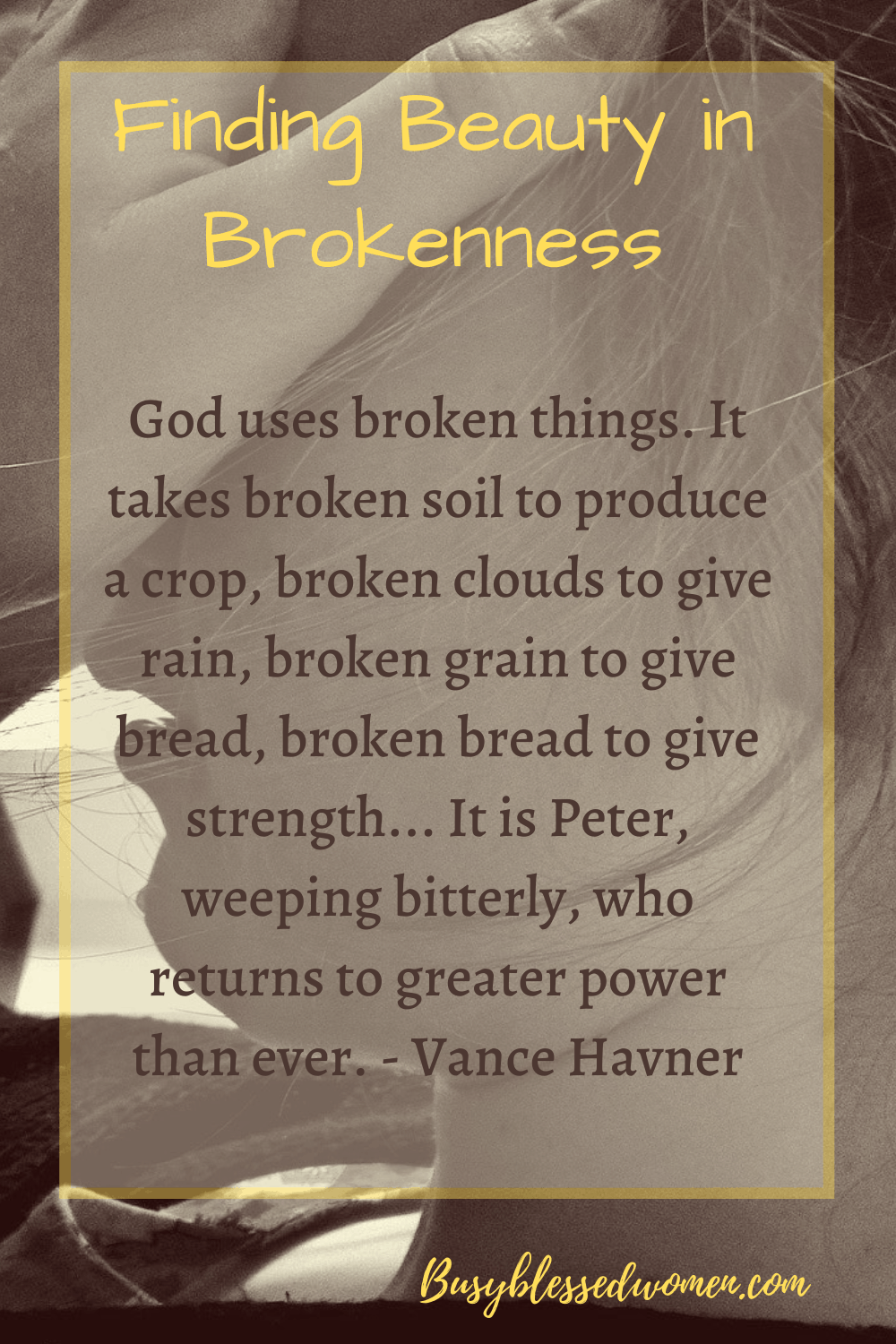
 From Pity to Praise