
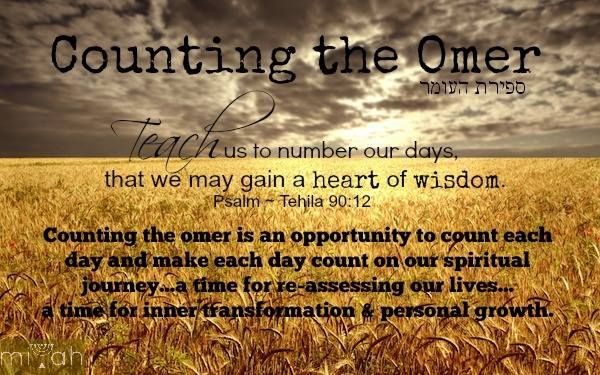
Counting The Omer
From the second night of Passover until the day of Pentecost. God’s people engage in an unique mitzvah (a religious duty) called counting of the Omer. While it’s not good to become religious these 49 days can change your life if you pay attention to this command in the Bible.
The Bible commands us that during this time each year we count seven complete weeks, for 49 days. At the end of the seven week periods celebrate Pentecost (or Shavuot), which means weeks.
This is considered a mitzvah, so the count, which takes place each night, is preceded by a blessing. Hover, we may recite the blessing on,y if we have not missed a single day’s counting. (There are apps you can get on your phone or computer to be involved in this yearly count and blessings). If you have omitted the counting even one night during that stretch and don’t make it up during the day time without reciting the blessing, we may no longer recite the blessing,
The days in the Bible start at 6:00pm to 6:00pm so each nights count for the following day.
During the times of the Holy Temple, at the beginning of the Omer count and on the following holiday of Pentecost (Shavuot), special grain offerings were waved in different directions to demonstrate God’s Almighty’s all encompassing presence
Why Do People Count The Omer Today?
We learn several reasons. The foremost is that this count demonstrates our thrill for the impending occasion of receiving the Bible celebrated on Pentecost. Just as a child often counts the days until the end of school or an undo I get family vacation, we count the days to show our excitement at again receiving the Bible in a renewed sense every year,
We also learn that this person is meant to spiritually prepare and refine ourselves. When the Jewish people were in Egypt nearly 3,400 years ago, they had assimilated many of the immoral ways of the Egyptian people. The Jews had sunk to an unprecedented level of spiritual defilement and were on the brink of destruction (just as we are today). At the least possible moment, the children of Israel were miraculously redeemed. God chose Moses to bring them out of slavery. They underwent spiritual rebirth and qui ascended to the holiest collective state that had ever reached. (Maybe We are like the Jewish people who were in bondage for all those years). The fact that they had become Holy and were compared to angels when they stood at the foot of Mt. Sinai to receive the Bible.
In was during that 49-day period that they underwent such a radical transformation. From the lowest lows to the highest heights in just seven weeks!
The commandments of the Bible are not meant merely as our history, but instead represent an ongoing life lesson for every one. May we view the Bible as freshly received every day of our lives, and approach it and it’s commandments with appropriate vigor.
When the Omer is counted and meditated over we can digest the lesion that it offers. It is specifically during these 49-days that we can strive to grow and mature in our spiritual state. The Bible does or allow us to become satisfied with our current level of spirituality. Instead it tells us to set high goals for ourselves, and them methodically strive to reach that goal.
If you want to become closer with God it’s a way for that to happen. Learn the lesson of Passover to Pentecost be counting the Omer. It can be read in 10 minutes a day and will keep your focus on the lesion God is trying to teach us during this time.
The Gift
You may not look like you are special. You may be so caught up in sin you think God is not looking at you and perhaps a messenger of God may cross your path and tell you “You are beautiful” and your reply is “you think I’m beautiful?” I’m here to tell you, you are beautifully and wonderfully made (Psalm 139:14). As a disciple of God, I choose to believe Him and His word as truth. There are so many lies being spread now and particularly to children and their parents. If satan can’t kill them out of the womb then he will try and flood them with lies so they will never become what God intended for them.
The agenda the world is promoting today are outright evil. God created all of us male or female and those two together are so powerful against satan and his plans. It’s no wonder he doesn’t want us to multiply.
I’m here to tell you this generation that is on earth today is a generation that is being birthed like the time of Moses and Jesus. They are called the Jacob generation. Pharaoh and Herod wanted babies killed because they feared their position as kings. Sons and Daughters of God can be kings under the King on earth like never seen before in this age. No one can stop and the move of God no matter how many delays, or how much the enemy of the soul could care less whether they die or go to heaven or hell. He just wants us outlc his way so he can do his evil works.
Ask God to reveal the evil so that you’re not deceived out of your life. And He will do it, and bless you beyond measure. Don’t waste you life. Have faith that Jesus died at the cross for your sins and confess with your mouth that He is Lord ask Him to come into your heart. Become born again. Set your love upon Him, know His name, call on Him in times of trouble. And He will answer and show you His salvation plan (Psalm 91).
The promises of God are sure, but right now the world is a war zone, and we need to rise up and be in God’s army. Let Him give you life and give it abundantly. That’s the reason Jesus came to do and wants to bring you along. We wants to take back what satan has stolen from you. He wants to give you power over the enemy. He wants to give you, authority over satan, He wants to give you peace, happiness and love. But He can only give you these gifts if your willing to receive them.
For nearly 30 years I allowed satan to take my soul, destroy my life, and make me an empty shell, with no love or compassion for anyone I came in contact with. I chose not to let Satan have control over my life anymore. I chose to be happy. I chose to make God the center of my life. Satan has taken so much from me. Don’t let him win. Choose to make God the center and cornerstone of your life. You are worth it.
Begin to live your life in peace with happiness and live it more abundantly. Don’t miss out on your true destiny. Let God be your light, kick Satan out of your life and the darkness will flee.
Accept God’s Gift Today
You Only Win…

He Is Risen
Why Is God A Jealous God?
It is important to understand how the word “jealous’ is used in Exodus 20:5 to describe God is different from how it is used to describe the sin of jealousy (Galatians 5:29).
When we use the word “jealous,’ we use it in the sense of being envious of someone who has something we do not have. A person might be jealous or envious of another person because they have a nice car or home (possessions). Or a person might be jealous because of some ability or skill that other person has (such as playing a instrument or being athletic).
In Exodus 20:5, it is not that God is jealous or envious because someone has something He needs or wants. Exodus 20:4-5 says, “You shall not make for yourself a idol in the form of anything in heaven above or on earth beneath or in the waters below. You shall not now down and worship them; for I, the Lord your God, am a jealous God… Notice that God is jealous when someone gives to another something that rightly belongs to Him.
In these verses, God is speaking of people making idols and bowing down and worshipping those idols instead of giving God the worship that be,ingest to Him alone. God is possessive of the worship and service that belong to Him. It is a sin (as God points out in this commandment) to worship or serve anything other than God. It is a sin when we desire, or we are envious, or jealous of so much because he has something that we do not have. It is a different use of the word “jealous” when God says He is jealous. What He is jealous of belongs to Him alone, and are to be given to Him alone.
A practical example will help us understand the difference. If a husband sees another man flirting with his wife, he is right to be jealous, for only he has the right to flirt with his wife. This type of jealousy is not sinful. It’s entirely appropriate. Jealousy is a sin when it’s a desire for something that doesn’t belong to you. Worship, praise, honor and adoration belong to God alone, for only He is truly worthy of it.
Therefore, God is rightly jealous when, worship, praise, honor or adoration is given to idols. This s precisely the jealousy the Apostle Paul described in 2 Corinthians 11:2, “I am jealous for you with a godly jealousy…”
Resurrection Sunday
For most of Mary Magdalene’s life, only her activities were recorded. There’s not a single thing that she spoke from the beginning of her life in Scripture, but her actions introduce her thoroughly. We get a clear picture of a women who she was one of Jesus’s closest and most devoted friends.
Jesus rescued her from the destructive grip of seven demons, and afterwards she never left His side. Instead of going back to life as normal, Mary Magdalene traveled with Jesus and the disciples. Mary stayed with Him at the cross, helped bury Him and hurried back to the grave as soon as the sabbath rest was over.
Mary Magdalene ran through the streets of Jerusalem “while it was dark,” seeking the One who called Himself light. But He was not there. The tomb was empty. As two angels looked on, Mary Magdalene wept. She hadn’t grasped the truth of His resurrection until He spoke her name: “Mary”.
The Lord speaks our name as well, in the depths of our hearts. He calls us to see Bin as He truly is: Risen, victorious, eternal. He calls us to believe, to leave the darkness of doubt behind step into the light of His truth.
On that sacred morning long ago, Mary Magdalene couldn’t keep the good news to here. She went to the disciples, just as Jesus had commanded her, and told them, “I have seen to Lord!”
He urges all of us who love Him to do the same. To tell everyone who will listen. “The Lord is alive. He is real. And here’s how much He loves you.” Let’s emulate Mary Magdalene, developing a tender heart, cultivating lives with our actions, by generating words that let others know that we have seen the Lord.
John 20:11-18
Holy Saturday

Holy Saturday
Holy Saturday Commemorates The day that Jesus laid in the tomb after his death, According to the Bible it is the day after Good Friday and the day before Resurrection Sunday. It is also known as Easter Eve, Easter Even, or Black Saturday.
What Do People Do?
Merry Christians worldwide observe holy Saturday by remembering it was the day when she just laid in the tomb. It is a day of both sadness and joy among Christians in many cultures. Many churches hold Easter Eve service. Discussions about the meaning behind the service of prayer and symbols are all are all a part of Holy Saturday. I’m churches hold large baptism services on this day. I want to keep that but yes except I want to read it
So what does whole Saturday teach us? Mostly it’s about humanity. Traditionally, this is a solemn day of mourning. We are called to act as if someone be beloved in our family has died; we were asked to consider what it would have been like if we were close friends of Jesus when his wife was taken. This is not near spiritual pageantry- It’s where the rubber hits the road. When someone deer is taken from us, we once again realize that man was not made to be alone.
Traditionally we hold a view of human nature that highlights the fact that we are made for relationships, that we need each other. In 2020, darkness, despair and death hovered over our existence, while coronavirus is implicated in the deaths of many Americans as well as many across the globe. Quarantined left countless people alone, and forced to sit in isolation.
Statistics show rates of anxiety, depression, and suicide rocketed because of this pandemic. Spc that human being reap awful results when we suffer alone and convince ourselves this world is all there is.
Holy Saturday offers are remedy. The entire Christian message stands as a countercultural emblem that shouts out to a suffering world that Hope truly does reign.
Hope it’s not blind trust nor a mental exercise in spiritual roulette that an outcome will turn out exactly as we desire. Hope is a condition in friendship when you know your friend is with you, even when He is not physically next to you. Hope is the capacity to see that we are never truly alone and that God can overcome any obstacle, even death.
Holy Week personifies Christian hope. During Holy Saturday, we’d well to ponder two questions in particular: First, But we have left Christ all alone and His suffering? Second, how are we being asked to journey with others in their suffering today?
Good Friday unveil the rejection of Jesus, but that denial leads to hiding for the entire weekend. We are told that Jesus appears to his disciples, on the night of the first Passover, in an upper room, where, the doors were locked, where the disciples were, for fear, that they also be persecuted.
Of course, this means they were hiding since they deserted Jesus on Maundy Thursday evening, Content with allowing fear to trump hope and love. Unfortunately, there are countless Christians who choose to ignore Him and hide Hid importance Even in the holiest of days.
A day between Jesus’s death and the resurrection stands at a pivitol juncture between despair and Hope, fear and courage, death and new life. Holy Saturday was a real point in time, but it also symbolizes the current state of the world.
We are in a time in place between darkness and light, destruction and renewal. We are in desperate need of looking for brighter days for our country, politics, church, and the world. The tendency to turn inwards and become an individualistic must be avoided at all costs because we see more clearly now than ever,That isolation has awful consequences.That isolation has awful consequences.
Widespread suffering will strike again, it may not be coronavirus but suffering will strike again we must turn to others and embrace their presence as our hope. Holy week act as a prism into a cyclic nature of every person’s life. Everyone experiences times and great joy that sometimes turn into great tribulation.
He is to always remember that trials and darkness never last forever. The empty tomb always turned up empty in our lives always recover if we hold fast to hope. In our current times, Holy Saturday It’s lasting more than a day but the outcome remains the same.
How do you sit inside of the gloom of Holy Saturday and rightfully mourn the death of our Lord, Just recall that the only path forward is found in our loving relationship with others and in standing firm with our God. When we focus on the reality of what happens when the women arrive at the tomb early on Resurrection Sunday, we can more easily see they can present sufferings are nothing compared to the victory that awaits us.
What’s So Good About Good Friday?
Why do we call Good Friday “good,” when it is such a dark and bleak event commemorating a day of suffering and death for Jesus?
Good Friday, the Friday before Easter (Resurrection Sunday), is a Christian Holy day to commemorate the crucifixion of Jesus and His death at Calvary. It is also known as Holy Friday, Great Friday and Black Friday.
For many Christians, Good Friday is a crucial day of the year because it celebrates what we believe to be the most momentous weekend in history of the world. Ever since Jesus died and was raised, Christians have proclaimed the cross and resurrection of Jesus to be the decisive turning point for all creation. Apostle Paul considered it to be “of first importance “ that Jesus died for our sins, was buried, and as raised to life on the third day, in all accordance with what God had promised all alone in the Scriptures (1 Corinthians 15:3). It is the belief followers of Christ base their Salvation on.
On Good Friday we remember the day Jesus willingly suffered and died by crucifixion as the ultimate sacrifice for our sins (1 John 1:10). It is followed by resurrection Sunday (or Easter, the glorious celebration of the day Jesus was raised from the dead, heralding His victory over sin and death and pointing ahead to a future resurrection for all who are United to Him by faith (Romans 6:5).
What Is The Meaning Of Calling It “Good” Friday?
Still, why call the day of Jesus’s death “Good Friday “ instead of “Bad Friday” or something similar? Some Christian traditions do take this approach: in German, for example, the day is called “Sorrowful Friday.” In English in fact, the original term “Good” is debated: some believe it developed from an older name, “God’s Friday.” Regardless of the origin, the name Good Friday is entirely appropriate because the suffering and death of Jesus, as terrible as it was, marked the dramatic culmination of God’s plan to save His people from their sins.
In order for the good news of the gospel to have meaning for us, we first have to understand the bad news of our condition as sinful people under condemnation. The good news of deliverance only makes sense once we see how we are enslaved. Another ways of saying that is that it is important to understand and distinguish between law and gospel in Scripture. We need the law first to show us how hopeless our condition is; then the gospel of Jesus’s grace comes and brings us relief and salvation.
In the same way, Good Friday is “good’ because as terrible as that day was, it had to happen for us to receive the joy of the resurrection (Easter). The wrath of God against sin had to be poured out on Jesus, the perfect sacrifice substitute, in order for forgiveness and salvation to be poured out to the nations. Without that awful day of suffering, sorrow, and shed blood at the cross, God could not be both “just and the justifier” of those who trust in Jesus (Romans 3:26). Paradoxically, the day that seemed to be the greatest triumph of evil was actually the death blow In God’s gloriously good plan to redeem the world from bondage. (and that’s why Satan wants our souls, and he will do any thing in his power to get it).
The cross is where we see the convergence of great suffering and God’s forgiveness. Psalms 85:10 sings of a day when “righteousness and peace” will kiss each other.” The cross of Jesus is where that occurred, where God’s demands, His righteousness, coincided with His mercy, and peace because Jesus willingly took our divine punishment, the result of God’s righteousness against sin. “ For the joy set before Him” (Hebrews 12:2). Jesus endured the cross on Good Friday, knowing it led to His resurrection, our salvation, and the beginning of God’s reign of righteousness and peace.
Good Friday marks the day when wrath and mercy met at the cross. That’s why Good Friday is so dark and so Good.
Fact:
It is believed that the name Easter was drawn from the pagan god Eostre. Every spring the pagans would celebrate this deity with a festival. Eostre was the pagan goddess of spring and fertility and such did the festival and season follow.
The Lord’s Supper
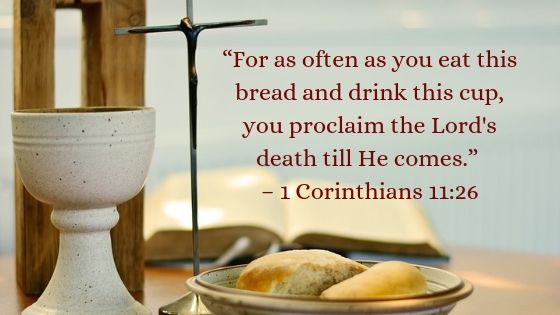
The Last Supper
The 12 disciples were in a daze. For the first time They weren’t celebrating Passover as prescribed in the law of Moses. Or if they did, this one was added. Jesus arranged that the upper room be prepared for this special meal together,The meal that we share together before He would suffer.
This meal has characteristics of the Passover. But it differed in a number of ways, a key being the bread and the wine at the center of it. And Jesus taking the red declared it to be His body broken for them. The cup Jesus declared as His blood poured out for them.
His disciples surely couldn’t make no sense it out of this at all. This seemed to them to indicate that Jesus was not the Messiah. Yes something powerful held them there. I knew fellowship was being formed around a new table. And for a new world. Jesus indeed in the food. The life of a new creation is in Him, And for the world Jesus was in their midst in a way that from now on by the spirit He would continue to be whenever they would share this meal together and do it in remembrance of Him.
Many believe Jesus’s instruction to do this goes beyond taking communion. It also refers to how we are to live. Because Jesus’s body was broken, because His blood was poured out for us, we too should live daily for Him, broken and poured out.
Jesus isn’t inviting us to a life of comfort and ease but one of surrender and sacrifice. Our highest desire shouldn’t be for our will to be done but for His will to be done, And Jesus is inviting us die in our own lives so we can live moment by moment, day by day – for Him.
Communion is a sacred time for you as a follower of Jesus. But before you participate in this memorable occasion, take time to spend some reflective moments and self examination. What does that mean? How can you pray? While this is an individual matter between you and God, here are some communion prayer thoughts and meditations that might help you as you prepare for this beautiful time of remembrance.
Communion Scripture
And as they were eating, Jesus took the bread, blessed and broke it, gave it to the disciples and said, Take, eat; this is my body, then He took the cup, and gave thanks, and gave it to them, saying, drink from it, all of you. For this is my blood of the new covenant, which is shed for many for the remission of sins
Matthew 26:26-28
“Jesus said to them, very truly I tell you, unless you eat the flesh of the Son of Man and drink His blood, you have no life in you. Whoever eats my flesh and drink my blood has eternal life, and I will raise them up at the last day.” (John 6:53-54).
And when he had given thanks, he broke it and said: “ this is my body, which is for you; do this in remembrance of me.” In the same way, after supper He took the cup saying: “ Cup is the new covenant in my blood; do this whenever you drink it, and remembrance of me.”
For whenever you eat this bread and drink this cup, you proclaim the Lord’s death until it comes. So then,, whoever Is this bread or drink this cup of the Lord and unworthy manner will be guilty of sinning against the body and blood of the Lord. Everyone actually examine them selves before they eat their bread and drink from the cup.” (1 Corinthians 11:24-28).
 From Pity to Praise